The Forgotten

Meredith dragged me along as she ran, pulling my arm so violently I feared my shoulder might fly from my socket. Behind us I heard a cry in a strange accent, a word I thought I knew, though I could not place it. I whispered it to myself as I tried to keep up to Meredith and she glared at me furiously, yanking even harder upon my arm. The sounds of pursuit grew nearer as we ducked around a corner and into a broad alley, weaving around trash dumpsters. One of the pursuers—the man with the goggles, I was certain—uttered a command and somehow I knew they were splitting up to cut off our avenues of escape.

I began to say something, but Meredith silenced me with a glance. Directly in our path were two cooks in stained white jackets outside having a smoke break and Meredith headed for them with me in tow. They glanced up in surprise at our rapid approach, their astonishment soon replaced by fear as they saw the man behind us in pursuit. Their conversation silenced they watched us, open-mouthed and frozen in place, as Meredith blew past them, carrying me with her. She threw open the door leading into the kitchen, with such violence it almost rebounded off the wall to hit us, and we plunged within before either cook had time to recover and do anything.

Inside we were met by a shout of anger from another cook and a stunned shriek from the waitress we bowled over as we dodged through the galleys. By the time I noticed the scalding heat hitting my face, we were already out of kitchen, emerging to find ourselves near a bar. A couple, with their arms slung over each other as they leaned against the counter, glanced up at our sudden entrance. Again I noted the long delay before the surprise registered on their faces. Was time moving slower for me, each instant fuller than the last?

I had no time to think about that for Meredith did not pause, flying around the bar, shoving aside anyone who came near our path, and it was all I could do to keep up with her. The staff was slow to react as well, only moving in our direction when we reached the entrance to the place. By then shouts and cries began to arise again from the kitchen and a low murmur of consternation erupted, cut silent by the door swinging shut behind me as we returned to the street. Here Meredith paused for a second to get her bearings, glancing left and right. My face felt hot and my pulse echoed loudly in my temple. I could not seem to get enough air into my lungs. Continue reading →

The Forgotten

The Cafe Beano was a coffee shop on the corner of a busy avenue not far from the apartment building, a place I was convinced I had been before, though no memory would come to me. Yet I knew where it was and could picture its cluttered interior, with tables and chairs strewn about seemingly at random, could smell the bitter coffee and hear the chatter of the menagerie of people gathered within its walls. It was the specificity of these memories that seemed the strangest of all to me. Why could I recall with exacting detail everything about the Beano, but not remember having been there or anywhere else in this city, wherever it was? It was if someone had planted the memory whole within me, but left aside all the context, all the things that made a memory personal. This recollection could have been anyone’s, just as I could be anyone, and that was what bothered me most of all.

Meredith might be able to help there, I reasoned, as I walked back through the park to the coffee shop. All those things which had seemed so significant earlier—the couple talking, the movement of the light through the tree branches, the damp smell of the earth—I noted now in a glancing way, giving them no real thought, my mind on how to proceed with Meredith. Did I reveal to her that I had no memory of who I was? Could I trust her with that information? Best to wait until I better understood what she wanted and go from there, I decided.

I had a sudden moment of panic as I stepped into the Cafe Beano, glancing about at the faces of those sitting at the tables or standing in line for coffee, and realized I had no idea what Meredith looked like. If she was already here I would have no way of finding her—how had this not occurred to me before, I wondered, feeling my face go red—and there would be no hiding my memory loss from her. Realizing there was nothing else for it now that I was here, I went and stood in line, fidgeting and glancing about to see if anyone in the place was trying to meet my eyes.

As I waited a slim woman, with hair that wavered between blond and brown, depending on the light, pulled tight into a dancer’s bun that peaked atop her head, came alongside me and said in a quiet voice, so unlike the one she had used on the phone, “I’ll get a table at the back. Get me a latte.” Continue reading →

Now Available: The Masks of Honor

Masks of Honor

Luisa is always more than she appears. Rumor and mystery surround her. And strange events seem to follow wherever she goes.

Born in Lima, City of Kings, to a noble family, her father so fears her true nature that he banishes her to a convent. There she falls under the suspicion of the Inquisition and decides to flee.

How can a young woman hope to hide herself in colonial Peru, where honor is prized above all else? By adopting whatever masks respectability requires. It is only when someone is able to pierce the veil of her mask that the real danger begins.

In a world where she will always stand apart, Luisa embarks on an adventure, marked by betrayal and murder, terrible powers and mysterious strangers. The Masks of Honor is her incredible confession and a story like no other.

A novel by Clint Westgard
Available at Amazon, Kobo, and Smashwords

A Nefarious Rite

When I slipped out of my room it was deep in the night, well past second sleep, when not an honorable soul could be expected to be about in the world. I was at one with the shadows as I moved through Don Francisco’s hallways, going from room to room, verifying again that all were empty of inhabitants. As I inspected what were ostensibly the servants’ quarters more closely than I had the previous night, I was convinced that no soul ever lay their head upon those rough pillows. When I had satisfied myself that the house was empty, I turned to the grounds, scouring the stable where Don Francisco kept his horses, along with a few pigs and some cattle, finding no sign of anyone there either.

I returned to the house, convinced that I must have overlooked something there. A dozen Indians and a Castilian could not simply vanish into the air, even if the man was an alchemist, as he claimed. I retraced my earlier steps within, this time going slowly so that I could feel at the seams of the place, here at the floor, there at a fireplace, trying to find some secret passageway. None appeared, until I came to what appeared to be a newer addition to the house attached to the kitchens, which I had only glanced at on my earlier journey. At its far end, near where the entrance to the cellar was, there was an empty space, absent of purpose.

I went to it immediately, crouching down to run my hands along the floor, and was rewarded with the discovery of a trapdoor. I pulled it up and saw some wooden stairs descending into the inky blackness below. After checking to ensure that the door would not lock behind me, I went below. The darkness was near absolute, but I have always been at ease in the dark. When I came to the bottom of the stairs I could discern a pathway, carved from the earth and supported by timbers, as though it were the shaft of a mine. I half expected to be assaulted by the sound of pickaxes upon rocks and the searing stench of quicksilver, but the silence and the darkness held firm.

I started forward, the smell of damp earth heavy in my nostrils, unease tickling at the hairs on my neck. The farther I went the farther I was from my only avenue of escape, and the damper my palms and the drier my throat became. I walked for what seemed like hours, though in all likelihood it was only a few interminable minutes, the silence playing on my thoughts until my imagination had filled my head with any number of fearsome and terrible sights that I was certain were about to be revealed to me. The passage narrowed as I went until it came to a turn—somewhere near the edge of the professor’s land, I reasoned—and after I had made the turn a dim light flickered into view at the end of this new tunnel. I slowed my approach, being careful to make absolutely no sound as I went, though I could hear nothing from the room where the light was.

I crouched low as I came to the entrance and peered around the corner, my body pressed against the cold earth. Within I saw a cavern, ancient and wide, formed long ago by the vagaries of the earth. I paid little mind to this wonder, though, for a far stranger sight drew my attention: all the professor’s servants were arrayed in a circle upon the cavern floor, each of them with a vial attached to their arms. Studying them closely, I could see that these vials were being filled with blood dripping slowly from small punctures on the Indians’ wrists. At the center of this nefarious circle was a goblet that, I knew without looking, was filled with blood.

I hissed at the sight of it, recalling the terrible rites the Stranger had been carrying out in the tombs of Cuzco. What foul necromancy was taking place here? I turned my attention to the poor Indians whose blood was being stolen, shaking the nearest to me to see if they were asleep. He did not rouse, and no breath seemed to pass from his lips. Had they somehow passed from the realm of the living and now inhabited some purgatory in this place? I was so engrossed in my study of the Indians, my own horror rising like bile in my throat, that I did not notice the shadows begin to move until it was too late. A firm blow struck my head and I fell to the ground and was lost to oblivion.

When I awoke, the light in the cavern had gone out and the Indians had risen, only the goblet remaining at the center of the circle. I was at the far end of the cave, my wrists and ankles chained to some ancient stone lodged in the earth. I had no idea how long I had been unconscious, but I suspected it had been some time and that morning would be near. Would Diego be joining me soon, I wondered? As if in answer to my thought, he appeared, led by Don Francisco. I called to him but he gave no sign that he heard me, his face blank of thought and expression.

A chill went down my spine at this sight, and my horror only grew as Don Francisco led the boy to where his Indians had so recently lain having their life force drained from them. He drew a thin knife from his belt that I could see was ornamented with oddly shaped runes, along with one of those fiendish vials of his. That he tied to Diego’s wrist, muttering some phrases in Latin, the knife poised in his hand. He pierced the boy on each wrist, one draining into the vial, the other left to open to feed the earth.

Diego, you are not his, I called to him. You must resist him.

Don Francisco laughed at my words. He is yours no longer, he said to me, leaving the boy and walking over to me, a malicious look in his eyes. Soon enough he will be mine, as docile as all the sheep in my flock.

I spat on the ground at his feet, cursing his name. What of me, I said. Do you expect me to be transmuted into one of your automata?

No, he said. Your kind does not respond well to my treatments. I have other plans for you.

What are your plans for the boy and these others, I asked, my fury growing by the instant. Are they to be drained until they are husks. I thought you were educating them and turning them into Christians.

Indeed I am, the professor insisted. Christians and good subjects. They are obedient and observant, not the slothful and ignorant sort like your boy here. He will learn his place in time.

Christians? I laughed at him. What claim do you have to our true faith? What foul rite are you practicing here?

Don Francisco looked at me scornfully. I am a philosopher and learned man and I will not have someone of your kind saying that I am not a Christian or a man. What you see here is no black rite, no foul magick, but a philosophic investigation into the most important alchemical secrets of our age. What I am collecting here is the divine quintessence of this land. This is the secret Magnus told Aquinas upon his deathbed, the secret to eternity itself.

As for you, he continued, stroking his chin with his fingers, a dear friend has requested that I keep you here. He is most eager to reacquaint himself with you.

My heart went still at his words and I felt myself begin to tremble. Though I tried to master my emotions they must have shown upon my face, for Don Francisco chuckled at my reaction.

Yes, I thought you would remember my friend. You are in his debt, as I understand it. You should know that he only accepts payment in blood.

I should not be surprised you would be in league with that devil, I cried, anger surging to overwhelm my fear. Do you do this work for him? He has worked his black magick on you as well.

Don Francisco scoffed at my rage. Don’t be a fool, he said. He is one of the great minds of this new world. A philosopher of existence to rival Magnus. It was he who taught me the secrets of the philosopher’s stone. But enough chatter, young Diego’s vial is full and I have much to teach him.

He turned his attention to the boy, untying the vial and emptying it in the cup, which was now full almost to the brim. He fingered it tenderly, as though it were the holiest of grails, and then pulled Diego to his feet and began to lead him away. He paused before he left the cavern, as though a thought had just occurred to him, and turned to say to me:

Tell me, then, I am given to understand from my friend that you can survive for quite some time without food or drink. We shall see, at any rate.

His laughter, grim and cold, echoed down the halls of the passage long after he had disappeared from sight. I was unable to stop myself from snarling and cursing like a rabid dog at him, but as soon as the sound of his mocking had vanished from the air I started to weep, for the Stranger was now on his way from Cuzco, and with him came my doom.

from The Maleficio Chronicles

Now Available: Realm of Shadows

Realm of Shadows eBook Cover

Discontent festers within the realms of Craitol and Renuih, fed by battles and intrigues carried out in the shadows. As rivals and apostates struggle for power, a new and more powerful menace looms on the horizon. For, in this world of shadows, it is the Shadow Men who stand apart, threatening the existence of both realms and exposing long simmering conflicts to the light of day. And now they have gained the secrets of the Council Adept’s alkemya.

Caught in the middle of this growing hostility is Masiph id Ezern, unfavored son of the Imperial Vazeir. As he tries to forge a path for himself within the empire, he finds himself drawn into a conspiracy against the emperor and his father. With the rains coming to the desert, the choices he makes will have consequences that reverberate across all the realms.

The first part of The Shadows’ Dance. The second volume, The Passing of Days, will be available in 2014.

A novel by Clint Westgard
Available at Amazon,  Kobo and Smashwords

The Disciple’s Inquiries

It had been raining on and off throughout the morning, a band of dark, heavy clouds settling over the city. For the moment it had halted, though there was a slight mist in the air. A miserable day, biting, with the wind and a damp that rotted at the bone. Disciple Hieran tramped, disgusted, through the streets to the Morning grounds, his foul mood made worse by the sight of two palanquins passing him on the road. He should have been used to it by now, but it still galled him that the Disciple of the Adept of Lastl did not have the coin to afford a rented palanquin in the rain. He cursed, not the first time, the Council for joining him to the greatest miser in the Realm. Not just a miser but a doddering old fool, more interested in his scrolls and specimens than the alkemyc arts. So, rather than practicing the art for which he had suffered years of training and disappointments, Hieran spent his days as the Adept’s errand boy.

No, it had all been disappointment and dreams denied since he had come, a supplicant, to the Council eight years ago. He had barely been a man then, though he was already a thaumaturge of some repute in his village Quilran, near Takyl. People came from villages over two days’ journey away just to have him heal their broken bones and the like. Unaware that there were men such as he in villages across the Realm, though few who were prodigies in thaumaturgy as he was, Hieran got it into his head that he should appeal to the Council to join their ranks.

And so, at fifteen, he had set out from home for Craitol, the Qraul’s city, to plead his case before the Council of Adepts. It was a harrowing journey for one who had hardly gone more than a day or so from Quilran. He spent a night in Takyl and was robbed and beaten and then spent another week on the streets of the city, begging for food and trying to find someone who would pay for his skills. When he had gained what he thought was enough coin for the journey he left Takyl, setting out for Craitol. His first two nights he spent at the roadside inns eating and drinking his fill and taking a girl to his room, only to find that his funds were nearly exhausted and the opportunities to earn more, which he had foolishly assumed would be there, were nonexistent. The rest of his journey he spent his nights in ditches under Senteur’s heavens and even had to spend two days outdoors in Craitol itself until he managed to convince the gatekeepers at the Council’s school that he was not some mere vagrant.

Fours years as a pupil passed with rigorous study of alkemya and its related arts. When he was deemed ready for elevation of rank, he submitted himself to the Council for testing, a grueling two-day affair where he had to demonstrate his abilities at drawing forth the astral aspects of various elements and shaping them into seeds of alkemy. He was judged to be of the highest proficiency and was admitted to the Council’s inner circle, though they felt him lacking in some critical faculties and so named him a Disciple rather than an Adept. He should have been happy, for most who passed the tests—and there were many who did not—were left to the Council’s outer circle to pass their days as unjoined conjurors, little grander in the scheme of things than a village thaumaturge. But instead, he was crushed by his failure to be named an Adept, a loss made all the keener by his joining to the Adept of Lastl. That hurt had not been lessened by the passage of time, mostly because his master Tehh was a man he thoroughly despised. And he had to suffer to submit, all his skill, the very astral of his being, to the service of that man, never his to be the guiding hand.

The Morning Grounds were not far from the Palace and the coliseum. Nearest the street was the public match ground and attached to it were the Morning’s betting and performing halls. Beyond that, and behind a wall, were the barracks and training fields for the players and a larger performing hall where the Morning’s musicians, actors, and dancers would put on their grander performances. There was a match set for the afternoon, the Morning’s third rank against Midday’s, which was the reason Hieran had to suffer the rain. He praised the Gods that he would not have to endure the stands.

He went to the wagering hall, which was empty but for a few bettors and the usual hangers-on, stopping first at a stand near the entrance to buy a dala drink to warm himself, before beginning to wander around. He didn’t have long to wait – a bookmaker approached him almost immediately. The man was short and a little stout, with a mess of hair that was starting to thin. His face was guarded in the way all such men were and he nodded a greeting at Hieran, which he returned in kind, neither of them particularly caring for the other’s name.

“What have you?” Hieran asked.

The bookmaker shrugged noncommittally. “Depends, depends. Suppose you’re looking for some asyl. I know some people who have dealings with some Enir traders. Long story, but they just got their latest supply last week. Very good quality, you cannot find its like in this city. You’re a man of quality, I can see.”

“Quite,” the Disciple said. “That’s not what I’m interested in today, though. I’m wondering about the odds for today’s match. I’ve heard one of your stringers has gone missing.”

A merest shrug of the shoulders. How am I to keep track of the comings and goings of these players?

“They probably don’t have a replacement just yet, he only went yesterday.”

The bookmaker waved his hand, “Pssh. He wasn’t much of a player, you know. Could hardly manage a toss. He wasn’t moving up the rankings, surely. No one’s going to notice him missing, I can assure you of that.

“No, no sense throwing money after this today. There’s no coin here,” he said, gesturing about the hall. “Besides, it’s going to be raining all day. Who wants to be sitting out in that? Now I have to, mind you, but I certainly don’t encourage such behavior. No, your coin is better spent elsewhere. I happen to have the acquaintance of a few of the finer dancers of the Morning who will most certainly be free this afternoon. Why pay market price in the arches when a finer commodity is on offer and at fair coin?”

“Quality again.”

“Indeed. Fair coin for fair coin.”

“Sadly, I am on official business.”

“Aren’t we all.”

Hieran smiled slightly. “From the Palace.”

The bookmaker went silent, frowning. Hieran increased his smile. “You wouldn’t happen to know a gentleman named Fennen? A Morning supporter.”

“He was around,” the bookmaker said.

“He was a Palace guard,” the Disciple said, followed by a shrug from the bookmaker. What of it?

“He was killed yesterday, in the alley of one of the Morning drinkeries. You probably heard. His face was disfigured.”

Another shrug, though Hieran thought he detected some nervousness about the man. The wrong answer was now a dangerous proposition. If people were having Palace guards murdered they would not hesitate to do the same to an odds man.

“He owed you money,” Hieran said, gesturing to the betting hall. “A great deal of money, am I correct?”

“I wouldn’t know. I didn’t take his bets.”

Hieran stared hard at the man, waiting. “I wouldn’t know,” he repeated.

“I am not a Magistery, obviously, but I do have the authority of the Gver to arrest you.”

“On what basis?” the bookmaker demanded. It was Hieran’s turn to shrug. What did it matter? He did not take his eyes from the bookmaker’s.

“He has no debts with us,” the bookmaker said at last.

Hieran let out a silent Ah. “How were they settled?”

The bookmaker had turned to stone, not even blinking. He did not answer.

Coincidences and more coincidences, all very convenient. Fennen’s debts gone though not paid, and he murdered. A no-rank ball player vanishes at the same time and no one knows a thing about him past or future. In fact, no one knew anything – how long he had been with the Morning in Lastl, who he had spent time with, what he had done.

He had wandered through the betting hall and then over to the theater where some actors were running lines for that afternoon’s performance and received much the same response. Everyone knew who he was speaking of, but whether they knew what had happened to him or not, they kept silent. A series of shrugs and avoided glances was all he got in return for his questions. How thick they all were.

It was to be expected, of course, and no one had bothered with coming up with a lie yet, which suggested that they did not attach any real importance to the man’s disappearance. They simply saw no need to cooperate with a Palace man. It was not unheard of for a stringer to vanish without reason. They hardly made enough to keep themselves in food, and at some point most were forced to admit that they were not going to rise through the ranks. A merchant wanting to have his rivals good stolen or anyone looking to have some brutality done to someone would come looking for just such a man, and if the money was good enough, well, why bother coming back?

He went into one of the barracks and began speaking to a hungover stringer, having talked his way past the gatekeepers and into the compound. The player’s face was such an ashen color that Hieran felt ill just looking at him. He wasn’t getting much out of the fellow beyond grunts and “Lazul was a good sort,” so he decided to press on and see who else he could find that might volunteer more, or at least let something slip. He was met at the door by two hired swords, northerners by the look of them, who blocked his way with their short blades.

“I am from the Palace,” he told them as though unfurling a passkey.

They did not reply, one of them simply stepping aside to allow him room to pass, jerking his head as he did so. Hieran considered arguing the point but decided against it and allowed himself to be led outside. The two swords walked on either side of him, neither bothering to sheath their swords, leading him along a path deeper into the Morning grounds. They were given a wide berth by everyone they passed, which was disconcerting, and he was taken to what he assumed was the estate of the Morning Chair. It was a sprawling building, three storied, with balconies and what looked like some walled gardens behind.

A servant let them in, observing their passage without expression. Panic seized Hieran once he realized that they were not going to throw him off the grounds. Instead they led him downstairs past the wine cellar, and through another basement before coming through a door to a cell. They stopped and one of the men unlocked the door while the other leveled his sword at Hieran. He glanced about, trying to get what bearings he could in the gloom. The smell of earth was heavy in the air.

Once the door was open, the man gestured with his sword for Hieran to enter to the cell. He almost refused, ready to make his stand there, but thought better of it. It wasn’t like they would kill him; the Chair of Morning could not afford to defy the Gver in such a way. The whole situation was bizarre. Why, if he was on the right track, draw such attention by imprisoning a Palace representative?

Stepping into the cell, he started to say, “This is outrageous, you understand,” and then one of them struck him hard on the back of the head. He fell to the floor with a grunt. Another blow and he felt as though he were floating atop an ebbing tide. He tried to look up at his attackers but he had no sense of whether he was actually moving his head or not. All he could see were waves of color that swirled across his vision. Another blow and the colors went, the gloom descending to dark.

from Realm of Shadows

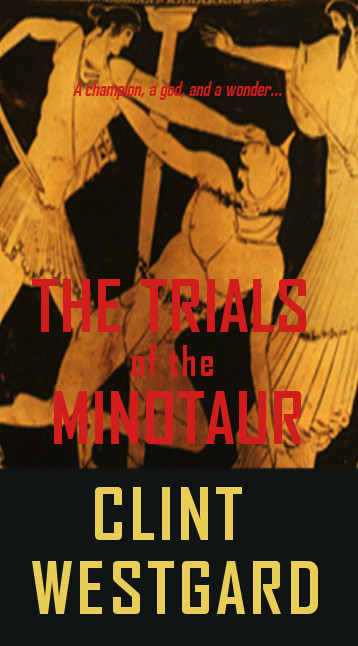
Now Available: The The Trials of the Minotaur

The Trials of the Minotaur

In the fifth year of the rule of Auten the One Eyed a minotaur was born to one of the imperial city of Colosi’s most important patrician families. The Trials of the Minotaur tells his story, following his life from despair and exile to triumph in the pantheon of Colosi. Betrayed at the hands of those closest to him, he achieves wealth and power beyond imagining as the oracle of a barbarian city, only to be cast out and turned into the star attraction of a traveling cabinet of curiosities.

Including all three volumes: The Blind Minotaur, The Oracle’s Mortification, and The Wondrous Beast.

By Clint Westgard
Published November, 2013
Available at Amazon, Kobo, and Smashwords

An Attempted Escape

At last the sight of the Stranger watching me from the shadows, his eyes telling me that my dreams of the horrors he would visit upon my person would in time become all too real, was too much. I had to escape San Sebastián and Cuzco and fly as far away as possible, so I set about to craft a plan. Normally I would have used the night to shelter my escape, but the aid it offered me was negated entirely by the presence of the Stranger and his terrible powers. That he had managed to survive our earlier confrontation told me that he was not a man in any sense that you or I would use, but rather a devil incarnate with all the magic that a demon might have upon this earth. I could not hope to defeat him, and certainly I could not evade him along with all the others who maintained the siege. Instead I determined to flee during the day, though it offered me little protection. But the Stranger was not present among the watchers, as near as I could tell, during the daylight hours so, by necessity, it offered my best chance. But how to slip by the guard without attracting notice when I did not have darkness and obscurity as my ally?

I turned instead to my allies of blood and flesh within Cuzco, those friends who I knew I could trust and would not turn from me, no matter the threats and blandishments Don Lope and the Alcalde might offer. Here Diego was invaluable, for I sent him to my friend Don Mariano and a few others to ask for their aid and to explain what I had in mind. They in turn brought word to others they trusted and, when all was prepared, sent word through Diego to that effect. Here I acted quickly, for I suspected that Don Lope had his men following Diego and I needed to set things in motion before they realized what was afoot.

I chose the following Sunday, for the church would be at it’s busiest that day and the crowd would offer me greater cover. Don Mariano had sent me a new suit through Diego, which I wore in the hopes of providing a moment’s distraction from the watch, who had no doubt grown used to the usual frock which I had been forced to wear for the two months I had been under their gaze. As the church filled with parishioners and mass began I hid myself amongst them, my hat pulled low. I spied a few of Don Lope’s men among the worshipers and saw, to my delight, that they were scanning those gathered for a sign of me, knowing that I normally took mass at this time.

At the conclusion of mass the crowd began to let out into the street where the watch was kept and I put plan into action. Don Mariano had engaged two harlots to create a disturbance to draw the attention of the crowd. One of them, a lovely morenasa named Teresa, had spent the morning on the streets around the church selling candies, while the other, a mestiza named Geronima, arranged to pass by Teresa as she was selling her wares to those let out from the service. Teresa feigned to notice Geronima in turn and immediately confronted her, calling her a whore and all manner of things. Geronima responded in kind and they fell upon each other, scratching at each others faces and pulling their hair, creating a tremendous racket.

This had the desired effect, for the crowd exiting the church was drawn towards spectacle. The result was that the street was filled with a milling group of people, trying to make room for the two combatants, mingling with those keeping watch against me. The guards could not resist turning to watch what was happening as well, for most of them were now two months into the siege and they had long since grown bored with their uneventful duty. In the midst of the crowd, having attended mass, was one Pablo Vallojil, an Indian from Guamanga, and a servant of Don Mariano’s. He was the ostensible cause of the battle between the two women and when he had announced his presence to the assembled they both turned and set upon him as one.

Pablo drew his sword, saying that he would see an end to them both for so dishonoring him before the home of Our Lord. There was great deal of nonsense said back and forth between he and the ladies, with members of the crowd joining in and choosing their side of the dispute. Pablo declared he would suffer these harlots’ insults no more and took after them, brandishing his sword. They both fled, towards the Alcalde’s watch, and these honorable men responded by raising their swords against Pablo. A flurry of threats were uttered back and forth as Pablo demanded to be given the satisfaction of punishing these recalcitrant women, while the Alcalde’s men dismissed him as an Indian who had passed beyond all reason and sense.

It was then that Don Mariano and two of his friends happened upon the scene and came to Pablo’s aid, demanding the arrest of Teresa and Geronima. The Alcalde’s men refused, saying that by rights Pablo and Don Mariano should be arrested. Further insults were traded and soon everyone’s swords were drawn and a melee resulted that sent the still gathered crowd into a seething turmoil, as those nearest to the fight tried to get clear of the blades, while those at the back tried to get nearer to better see what was taking place.

I was in the midst of all this, having exited the church with the crowd at the end of mass. As the incidents had developed I had stayed towards the back of the gathering, nearer the church, but when the fight between the guards and Don Mariano broke out I seized my chance and began to slip through the crowd, hoping of course to make a break while the Alcalde’s men were otherwise preoccupied. I kept my head low and had my cloak drawn up high over my shoulders, so that between it and my hat little of face was shown. Moving at an angle away from the fight, but staying within the assemblage I went, neither slowly nor quickly, being careful not meet anyone’s gaze, until the crowd began to dissipate and I could see the open streets before me. Though every fiber of my being demanded that I flee then and there, I kept my wits and walked steadily on, a man about his business..

Just as I thought myself free a hand seized my shoulder and spun me about, nearly yanking my arm free from my torso and I found myself face to face with Don Lope himself. I gave a shout and he snarled at me: You are the devil himself.

From the City of the Vanished

Every Cursed Night

Clouds blanketed the sky, rippling bruises in the twilight. The city Darrhyn below, sprawling along the bend of a wide river, was draped in the resultant shadows, pierced only intermittently by the remnants of the day’s sun. Hurried figures passed from street to street in certain of its quarters to light the lamps, while others were left to what the night would bring. Along the city’s great wall the beacons in the towers were struck, signaling the changing of the Watch. The new quadras marched up tower stairs, the soldiers heading out to pace the ramparts, looking into the final glare of the sun as it cast the scrub of the desert in oranges and reds.

Within one of the watchtowers five men squinted in the lamplight at a just-overturned cup, none of them speaking. Above them the sentinel on duty was singing an academy song about a woman so light in her manners that she would invite any man to sup with her.

“Call,” the dealer said as he removed his hand from the cup, its contents still a mystery.

The youth to his left exhaled slowly as he eyed the cup. “Even. Five kenir,” he said, the flames of the beacon above them snapping as more oil was added.

“Odd. I’ll see you, Husem,” the man beside him said, and the youth grimaced. “You’re too young to be a gamester, I think.”

He had a face gone thick with age and a long scar that ran from his chin up to his ear, just above the line of his jaw on one side. When he grinned, as he was doing now, it had the effect of creating what seemed a double smile on that half of his face.

“He lacks ability,” the dealer said.

“Short on talent as well,” the man said, to the laughter of everyone but the youth. The others at the table followed through with their bets, all odd.

Masiph id Ezern bit his lip. “I hope this is all above board,” he said, staring at the dealer whose hand had strayed back to the cup.

“I hope so too,” the man, Achelluth, said. “Someone short on talent and without ability certainly can’t handle the underboard of life.”

Masiph bit his lip again, not replying, and the dealer pulled the cup away, revealing two dice—a four and a three. There were whoops from around the table, but he did not look up, his eyes fixed on the dull bones whose pips had betrayed him again.

“That’s it. I’m out,” he said, pushing the last of his coins across the table. “I’m getting some air.”

“Neither the coin nor the stamp for it, Husem,” Achelluth called out, the white of his scar almost gleaming. “You haven’t run through your allowance already, have you?”

“Hardly. I have better things to spend it on than at this table.”

“Well, at least you are wise enough to know you will be spending it here,” Achelluth said to more laughter. Masiph just nodded and walked out the door.

He wandered from the tower, stopping just outside the glow of the beacon to lean against the ramparts. It had been a cool day, given the rains could not be far away, and now that the sun was nearly set the night brought a chill. One of the two men on patrol on this stretch of the wall passed by, and they greeted each other. Masiph reached into the folds of his robe for the pouch that held his aslyn and put a quid in his cheek.

“Quiet night,” he said, as the soldier passed back in the other direction.

“Every cursed night is quiet, Husem.”

Masiph smiled, starting to work at the quid, as he stared idly at the veil of the night descending upon the desert. Here, so near the Eresnan River, it was a green desert—the short grass and sage brush that was its hallmark, plentiful and vibrant in color and scent. Once the rains began there would be even more as other plants began to flower. It was something he was curious to see, for though he had lived in Darrhyn his entire life he, like so many others from the city, had not set foot outside the western wall. When he had travelled it had been east into the Ferryen Plains, or down the Eresnan where the desert, so near, was safely kept from sight by the trees that lined its banks. To most Darrhynna, the desert was worthy of no more than a wary glance to the west and a scuff of a boot heel at the earth when talk turned to the Shadow Men.

Masiph had joined the Watch at the beginning of the dry season, five months ago, over his father’s objections. For once Ibrazol had relented, though it had not felt like a victory as Masiph had expected. It felt like his father had in some way outmaneuvered him again, achieving his desired end in allowing his son this. Perhaps he had. Masiph never could tell what his father’s thoughts were and was still not clear on his own feelings now that he had achieved his desire. The work itself was tedious—a few weeks on, a few days off, and always a quiet night.

This in spite of what one could hear walking the streets. To listen to the talk there was to believe that the Imperial city’s very existence was precarious, given its location in that nebulous region near the Empire’s border where the desert began. And the desert was the creatures’ domain. Never mind that the Shadow Men, even as they were conquering the desert, shattering the Empire a hundred years ago, had never dared an attack on Darrhyn and its fabled great walls. None had in the five centuries it had served as capital of Renuih.

There had been a raid a week ago in Fardun, little more than a day’s journey southeast—the first of the season, and earlier than usual, given the rains had not started. Strangely, the fact that it was an unimportant farming village seemed to lead to even more anguish among the populace. There was no sense to it, but why did there have to be? It was the creatures, after all. They were without reason and purpose, moving like common beasts with the seasons, content with the barest of existences on the rock and scrub of the desert.

In the streets talk turned to conspiracy and invasion. This was the only tangible result of a Shadow Men raid. That afternoon Masiph had heard that the shadows were gathering near Ghehel and were working to rebuild the Nasuila Bridge to use as a gateway to strike at the heart of the Empire, cutting the Ferryen Plains off from the capital and the southern provinces. At any given moment in the rainy season Darrhyn was a day or hours away from a massive army of the creatures materializing at its gates. In a week, maybe less, it would all be forgotten—until word of the next attack arrived.

We live in an age diminished, Masiph thought, the shadows of greater days. Before the fall of the desert, even during that desperate struggle to maintain their hold in that realm, the denizens of this city would never have cowered at the mention of a mere raid by the creatures. The thought would have been laughable. Now those who had to memorize their invocations, and even some of their betters, spoke of the Shadow Men as the natural inhabitants of the desert. Generations of Renians had known no other life but that of the desert—and that included his own family—yet that seemed to be almost forgotten now, or at least dismissed.

“What’s the thought this evening?” Nustef id Illied said to him as he stepped out of the tower. The Nohritai was older than his fellow nobleman, with narrow features and a heavier green tone to his skin than was usual for those from Darrhyn.

“We can only bear a life of fear so long,” Masiph said.

“Heavy things indeed, especially for someone with no marrow in his bones,” Nustef laughed.

“Where else do you find the pox but in the bones?”

“The voice of experience, perhaps? Are you preparing lines for your chronicle?”

“I don’t think so. The historians just put whatever words they want into the mouths of whoever anyway. Husem Azyereh was illiterate, I’ve been told.”

“Really?”

“Yes. He was not a favored cousin.”

More laughter. “Fair enough, I suppose. I always forget that he had a life before he became the Ad Eselte’s Vazeir.”

“Someday though,” Masiph said, “we’ll have to do something about the shadows or we’ll be nothing more than carrion for them to feast on. Better to act now than to be put to the squeak later.”

“You shouldn’t listen to what you hear in the drinkeries. It only bothers the blood.”

“The drink or the talk?” he said.

“I wouldn’t know these things. I lead a pious life, as my ancestors and the sage Delth proscribe.”

Masiph spat over the wall in response and Nustef smiled. “Talk to Our Most Benevolent One. Don’t you have his ear by now?”

“Oh yes, I join him daily for his constitutionals and we discuss all the important matters of the Empire in between verses.”

“Does he really go walking about every morning?”

Masiph shrugged. I would be the last to know.

Nustef took his own quid out, putting it in his cheek, and the two of them chewed in silence. There was a small copse near the wall that was filled with dahrrynna birds, the capital’s namesake, and their animated calls as they roused themselves for an evening of feasting on insects drowned the air. This was the scene that faced them every night as the sun slipped below the horizon, and that familiarity and the calm that now settled over the day’s end was seductive.

Masiph felt strongly about what he said regarding the creatures. It was an easy thing to be passionate about, given no one was so derelict of their senses as to invade the desert. A byproduct of the restlessness of youth, his father would say in that dismissive tone which burned his ears. That his father, and no doubt that useless philosopher Ad Eselte, frowned upon his views only served to confirm them even more firmly in his mind. Something would have to be done, if only because no one else seemed to think that was the case.

The last Renian force to invade the desert in an attempt to reclaim their birthright had been led by a cousin of his father’s, Waleen, ten years before his own birth. Two hundred sons, the flower of the Darrhynna youth, had joined him, dazzled by his speeches calling for a crusade to purify the desert of the black scourge, to resurrect those ancestors lost there and restore the empire whole. The result was predictable: a laughable disaster guided by a mad fool. Most failed to return and those who did were ruined, never to be whole again. Masiph had seen a few of them on visits to other Nohritai homes, balding men who walked about like children, unsure of each step.

Such a catastrophe had the effect of ensuring that no Ad Eselte or Nohritai would propose a war against the Shadow Men for generations. Still, Masiph admired Waleen his madness. His cousin, he thought, probably had felt much as he did the echo in each step of his life. If a cauldron of blood in the desert was necessary to drag this plain into a new age, then let it come.

“He’s a poet,” he said, breaking their silence. “He has the pouting lips for squeaking after all. Certainly no stomach for war.”

“Probably he’s too concerned about self-important Nohritai who think they know better than him how to run the empire.” Nustef said.

A clanging bell down the wall stifled Masiph’s reply. Just as it started to ring it dropped silent, leaving a dimming tremor of sound in the air before it began again in earnest. Both of them stood confused, unsure of what to do. The ringing stopped and did not resume, the darrhynna continuing their chatter, oblivious of this brief disruption, the alluring stillness holding

from Realm of Shadows: The Quiet of the Night

The Birth of a God

The Minotaur was never to return to Colosi again. After his flight from the empire, assisted by the sibyls of Hizen, he wandered aimlessly for a time in those barbarian lands so feared throughout the empire. He stayed clear of any towns and off any roads, remaining hidden in the wild lands, forested and mountainous, that the barbarians spoke of with awe and fear, for it was said they were inhabited with spirits and monsters. At last, tired of his wandering, and having no other place that he wished to go, he settled in a large cave. Its darkness, he felt, suited one who would pass his existence in obscurity forever more.

At first he would leave the cave daily to forage in the nearby wilds for what food he could find, mostly roots and berries, but as the seasons turned to autumn and then winter he rarely strayed outside his makeshift home. He ate less and less, growing so thin that his ribs showed through his coat, which had a ragged winter growth. He cared little, for it seemed to him inevitable that he would die here, and he saw no need to prolong this terrible misery. Instead, he feverishly plotted his revenge against Barthil Vulgih and those of his family who had conspired against him, imagining his triumphant return to Colosi to face his accusers on the sands of the pantheon.

Such dreaming was made all the worse for the fact that he knew such a thing could never happen. His life there was gone, replaced by this damp and miserable place. Still, it gave comfort to the long solitary days while hunger gnawed at his belly and mind. Soon enough, he imagined, he would be free of this realm, taken across that final river to the underworld where he would pass all eternity. That release was not to be granted him yet though.

In the months that he spent in his cave the Minotaur had not escaped the notice of local barbarians. Hunters were often seeking game in those forests and more than a few caught a glimpse of this strange beast, whose miraculous appearance they reported to their villages as proof of the place’s mystical powers. A few even trailed him back to his cave, a place that, unbeknownst to the Minotaur, was already considered a holy place of great power. As knowledge of presence spread among the barbarians they began to bring offerings to the mouth of the cave, especially if their hunt had been successful. It was felt, even among those who did not give much credence to these things, that good hunting would come to those who made whatever spirit inhabited the cave happy.

Little did they know that nothing could have mended the Minotaur’s heart at that time, so deep and absolute was his sorrow. He heard the coming and going of the hunters, their whispered invocations as they left their offering, but it never occurred to him to show himself to them. He did avail himself of their offerings, drinking the cups of wine and the hearts and tongues of the beasts they had killed. This only served to add to the power they ascribed him. By winter’s end even barbarians who did not hunt in the area began to make the journey to the cave to leave an offering to ensure that he was not angered.

As word of his imagined dominion spread, mystics and other sorts who claimed to have been touched by the barbarian gods began to journey to the cave to prostrate themselves there, chanting prayers and singing songs to his glory. None of these he understood, for the harsh barbarian tongue was unfamiliar to him. He ignored these penitents as best he could, slipping out of the cave under the cover of darkness to take the offerings and then retreating back within his claimed realm to feast. Few of those who came to make offerings had seen him, but the stories of his fearsome size from those who had were enough to engender awe.

Inevitably one of the penitents summoned the courage to confront the god of the cave. He was from a nearby village and said, by those who lived there, to have been touched by the gods, for he often had fits and fainting spells where he would rave madly in some tongue no one understood. The villagers called him Velthar the Sufferer and they feared him, unsure whether he was possessed by some demon come to torment them or a messenger of the greater path. He had no such doubts and when he heard of the creature in the cave that had brought such prosperity to those hunters who had made offerings this past winter, he went to there to chant and pray with the other penitents. Unlike those others, who came with offerings and paid their obeisance for a few days and then went on their way, he stayed on, praying and offering himself and his undying service to the being hidden within.

Weeks he stayed and still he received no sign that the creature was even aware of his existence. His faith was strong though and he remained, subsisting on what the forest offered, never once tempted by the many offerings left for the Minotaur. One night, as he lay awake, unable to sleep, just above the mouth of the cave, he saw through the branches of the trees above him a shadow pass over the moon blotting it from the sky. He watched, wondering if he were witnessing the end of all times, the sky growing dark, casting a shadow across all the lands in existence. Even as the darkness seemed absolute the shadow passed on and the moon gradually reappeared and he understood that it was a sign from the god within the cave intended for him alone.

Without hesitating he rose to his feet and entered the cave and was swallowed by the darkness within. He went slowly, crawling on his hands and knees, both to demonstrate his servility to the god and because he could not otherwise know where he was going. The floor of the cave was damp and cool, the smell of moss and earth heavy in his nostrils. At last he sensed the passage opening up into a deep cavern which seemed to him as though it had been untouched for untold ages. Here he felt the presence of the creature, could smell it in fact, a mixture of damp hair and the rotten breath of one who has been eating raw meat. He imagined that he could make out where the creature slumbered and he faced it crouched as he was, not daring to come any nearer. There he remained through the night.

The Minotaur had heard the man’s scuffling approach into the cavern, but he did not stir from where he lay, waiting to see what he would do. It had been, he knew, inevitable that one of the barbarians should at last gain the courage to confront him. His only hope lay in the fact that in the darkness of the cave the man would not realize his blind state and the advantage he held. When the barbarian did nothing, staying crouched where he was at the cavern’s opening, the Minotaur was not sure what to think. Was he blocking the way, preparing himself for the battle to come? The Minotaur could only assume this was the case, that here at last was a barbarian brave enough to confront the creature who was terrorizing the land and demanding such sacrifices as they were giving him. He had only known fear in his dealings with others, so it never occurred to him that the barbarians might be worshipping him.

Now that they had sent a champion to strike him down he both feared and welcomed it. Here was the ending that he had longed for through that long winter, and yet now that it had at last arrived he found he no longer wished to perish. The force of life had returned to his heart. As meager and pathetic as this existence was, living upon the sufferance of these savages, it was not something he was willing to surrender. So he decided to await for this protector of the barbarians to launch his attack. The darkness would be his ally and he would make this man come to him.

Morning came with neither of them having slept, the barbarian awaiting a sign from his chosen god, the Minotaur expecting an attack and a battle to the death. The Minotaur was the first to rise, the old wounds he had suffered in the pantheon and at the hands of the imperial guard, aching from too long spent on the cold and damp stone of the cave. He rose to his feet with the slightest of grunts and then moved silently deeper into the cavern where the stone formed a pool filled with water that came dripping from above. He drank his fill there and then went deeper yet into the darkness to relieve himself.

When he returned the barbarian was speaking. He had not, as near as the Minotaur could judge, moved from where he had lain the entire night. He had raised himself to his knees and was repeating the same group of phrases again and again, almost in a song. The Minotaur listened for some time, not moving, and then realized that the man was praying. Was he praying for strength, for his gods to aid him in the battle to come, or was he in fact praying to him? Was he a god to these savages? The thought almost made him laugh aloud given what he had been reduced to, but the longer he listened to the barbarian’s repeated chants, and the more time that passed without the man raising a weapon against him, the more he came to realize it was true.

He was unsure how exactly to handle this situation. How does one act a god when one is most assuredly not? The Minotaur had no idea and he feared what might happen should this man, and some of the others who slept beyond the cave, who he had assumed were guarding against him coming forth, determine he was not in any way holy and divine. The wrath of the pious scorned was legendary throughout history and he had no desire to be on the end of their swords. At the same time he could not hide from these men, nor did he have any wish to flee and start somewhere again when he had established a life for himself here, meager as it was.

Hardly knowing what he was doing, but realizing still that this very well would determine his path for the coming days and months, the Minotaur walked towards the penitent barbarian. The man ceased his chanting as the Minotaur came to stand over him. The Minotaur could sense the fear that was coursing through the man’s veins. He could almost see him cowering on the cavern floor. He stayed standing above him for a long time, as long as he dared, letting the tension blossom into terror. At last, when he felt the man might flee, he leaned down and touched his brow with his hand.

from The Oracle’s Mortification