The Body in the Coulee

The body lay part way down the coulee, right before the slope turned shear and plunged to the creek below. The night had hidden it, but the arrival of dawn made its presence obvious. There were several sets of footprints from where the body lay to the road, clearly marked in the muddy spring ground. Even as the new day’s light revealed these details the first flakes of snow began to fall, wet and heavy. For a time the earth resisted their intrusion but eventually the storm proved too much and the ground turned white, covering over the tracks.

Wayne Johnstone was the one to find it later that morning. He caught sight of the red jacket out of the corner of his eye from the tractor where he was tubgrinding feed for the cattle. Thinking it was something that had come off of a passing car on the highway, he drove up to the fence of the pasture by the lip of the slope to see what it might be. Something in him recognized just what and who it was without really looking and he sat in the tractor, his hands clutching the steering wheel, feeling very cold. After a time he clambered down the hillside, now slick with the accumulating snow, to confirm his suspicions.

Half an hour later a police car drove slowly up the driveway in the main yard, pulling to a stop in front of the ranch house where a woman sat on the porch, a dog at her feet and a hood thrown over her head to keep off the snow.

“‘Hello Diane,” Martin said as he stepped out of the car.

She just nodded, “It’s down there by the coulee,” she said pointing. “You can take your car if you think it can make it through the mud.”

“I’ll be alright.”

She paused, and then she said, “We called him. Wayne said I probably shouldn’t, but I had to.”

He nodded, “He’s down there now?”

“Yeah.”

He drove on through the yard down the laneways, pens filled with cattle still with their winter coats on either side, until he came to the far pen that connected out to the pasture. He sat there a moment to gather himself and then stepped out of the car, putting on his hat to keep the snow off. The pasture was almost entirely covered over in white, ruining the scene no doubt. If the weather forecaster on the radio was correct his drive back to town would be interesting as well by the time he was through here.

He climbed into the pen and set off for the pasture, nearly losing a shoe in the mud as he went. It smelled rank, a winter’s worth of manure and urine thawed and filling his nostrils. The cows ambled, and the calves darted, out of his way as he went, the footing growing more solid as he came to pasture. Still, he was glad he had not been tempted to try his luck with the car. The last thing he needed to add to the day was conducting a murder investigation while his vehicle was being pulled out of a pasture.

When he came to the fence separating the pasture from the coulee he saw them standing down the ridge a ways, looking down at the body, wiping the snow from their eyes. He cleared his throat and swung over the fence as they both turned to him. He just nodded at them and knelt down by the body. The face was mostly blown away. He could see the outline of one eye socket and most of the jaw, bits of brain and skull. Her neck and chest were perforated with pellet blasts. The blood was that curdled dark color, clumping against her skin and the earth below. He sighed and stood up, turning to Leonard.

“It’s her alright,” Leonard said. “That’s her jacket and shoes.”

Martin looked at Wayne, “Anybody else been down here but you two?”

Wayne shook his head.

“Alright. Why don’t you and Leonard head back to the house and wait for me. I want to look around a bit. Cory should be here pretty quick.”

“What’ll they do with the body?” Leonard asked, his tone odd.

“He’ll have to take it into town. Botha will have to look at it. We’ll take care of it.” He turned from them and knelt again by the body.

The snow had already obscured whatever tracks were around, but it seemed clear to him that she had been dragged here from the road. There was not enough blood around her, given the extent of her wounds, to say nothing of what had happened to the rest of her head. Why then had she been left here where the body would be easily discovered. A few steps farther would have taken whoever had carried her to the lip of the coulee where gravity would have carried the body into the darkness and trees. Of course, if all this had been carried out in the dead of the night without the benefit of a vehicle’s headlights, assuming the perpetrators were concerned about drawing attention to themselves, then whoever it had been might have thought they were closer to the precipice than they in fact were.

He paced from the body to the road. The fence along the ditch ended before the coulee started, and he wondered briefly why Wayne hadn’t bothered to extend it. There were no tracks into the ditch, which was hardly surprising given the snow. He climbed onto the road, kicking at the damp blacktop. It curved just ahead along with the coulee, the two running nearly parallel briefly, before the road curved again to wrap around it. The snow was coming down so heavily he could not see beyond that.

He went back to the body, snapping on the rubber gloves he had brought as he went, feeling faintly ridiculous as he did so. Wiping his eyes clear of water and snow he gingerly turned what was left of her head towards him and pulled back her remaining eyelid. The eye beneath was cloudy and the body itself stiff with rigor mortis, no doubt helped by the temperature, which had hovered around the freezing mark for most of the night through to the morning.

Martin stood, clicking his tongue against the roof of his mouth thoughtfully, and started to pull his gloves off when he spotted Cory heaving his bulk over the fence and waved him over. The ambulance drive wandered over, his jeans tucked into his unlaced work boots, his jacket open to the elements as well. He was unshaven and, as he came up alongside, Martin caught a whiff of booze.

“Late night?”

“Oh,” Cory said with a wave of his hand.

“You good to drive yet?”

“I made it here didn’t I?”

“Don’t make me put the fucking breathalyzer on you,” Martin said. “I’ve got enough shit to deal with without you cocking things up.”

Cory waved his hand again and turned his attention to the body. “Kristi Taid.”

“Yes,” Martin said.

“Cause of death shouldn’t be a problem anyway.”

“No.”

“Well, how you wanna do this? Bring the stretcher down from the highway, probably the easiest.”

Martin agreed and Cory returned through the pasture to where he had left the ambulance parked beside Martin’s car and then drove back through the yard and down the highway to where the coulee began. Martin met him there and they carried the stretcher down, moving the body onto it and then struggling back up the slippery ditch to the ambulance.

“Take it in to Botha then?” Cory said, turning to head to the cab of the vehicle.

“Yes,” Martin said. “And for fuck sakes Cory don’t phone anyone, don’t let anyone know. This is an RCMP investigation now.”

Cory didn’t reply, giving him another wave and then was on his way. Martin sighed and swore again under his breath. He stood and watched until the ambulance had disappeared into the snow that formed a wall to his vision on the other side of the Johnstone yard. He shivered and started on his way back to the yard, already thinking of the questions he would have to ask Leonard. 

From The Devious Kind by Clint Westgard
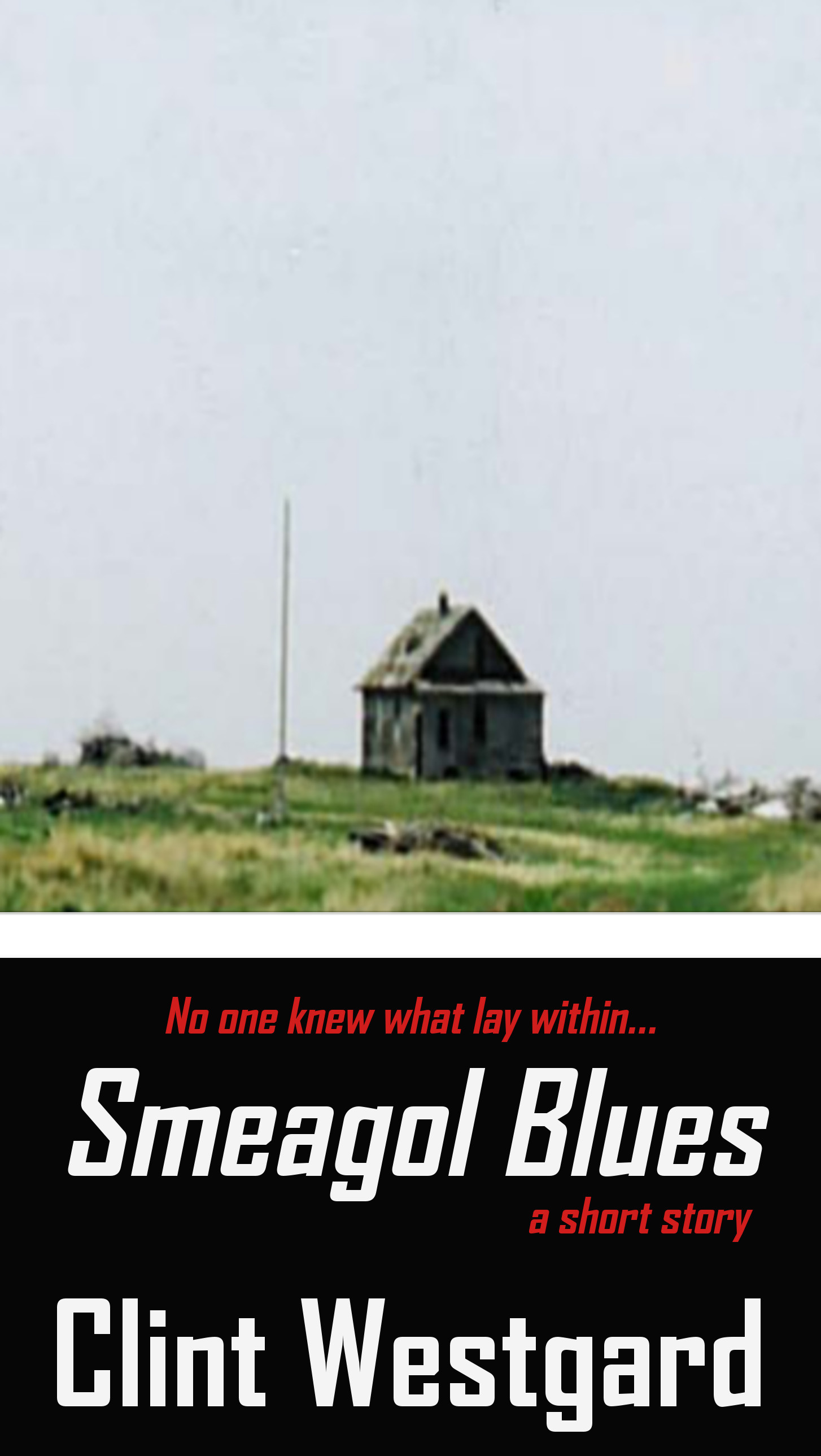
Now Available: Smeagol Blues

Smeagol Blues scaled

For as long as he can remember, growing up on the Canadian prairies, David has been drawn to the house. Called the Faulkenbourg Place by the locals after the Swede who had homesteaded the quarter, it is an unremarkable, ramshackle thing, worn by too many harsh seasons on the prairies. David’s curiosity will lead him to an investigation of the strange history of one of its inhabitants, Louie Glazer, a man who had disappeared without a trace thirty years before. Despite these  and other ominous signs he remains in its thrall, a power beyond his reckoning, that will lead him to an act of betrayal and a startling discovery as to the nature the nature of the place itself.

A short story by Clint Westgard
Available at Amazon, Kobo and Smashwords

The Ruin Of This Family

It was in the fifth year of the rule of Auten the One Eyed, the emperor of Rheadd during the second interregnum, that a minotaur was born to the daughter of an important patrician family, the Dethcalla. They have long had the ear of the emperor so it will surprise no one that nearly all mention of the Minotaur has been excised from the official chronicles of the day. However, a careful search of some of the more scandalous histories of the period does produce some mentions of the creature. That the creature existed cannot be doubted for, though unnamed, it is on the patrician rolls.

No one knew how Surys Dethcallen Barthil, the daughter of Barthil Dethcallan Vulgih had come to be with child, for she was unmarried and no more than fourteen. The Dethcalla had naturally followed the correct practice at every turn in her upbringing and her education was impeccable. To the best knowledge of the nurse and eunuch charged with her keep she had never been on the streets of Colosi, the imperial capital, unescorted or uncovered.

Once her father, a dour and forbidding soul, discovered her state, he strove to keep the facts of her condition as obscure as possible in an effort to avoid a scandal. The girl was not seen in public company, which was not unusual, for the unmarried daughters of important patricians rarely were anyway. He had her taken to his summer estate under the cover of darkness and amid much secrecy for her to carry the pregnancy to term over the fall and winter. He left only a few of his most trusted servants to see to her care, with strict instructions and the threat of execution that they should speak to no one.

If all had gone to plan the child would have disappeared to some orphanage in one of the distant imperial provinces, never to gain knowledge of its patrician birthright, with the rest of Colosi none the wiser. The child, however, came early, while Barthil Vulgih was still attending at court, his business and duty public. The last thing he wanted to do was to draw attention by fleeing the city, so he waited until the matters were resolved and then left to dispose of the child.

By the time he arrived, three days after he had received the message, there were six census officials awaiting him at the gate to add the newborn to the patrician rolls. Though furious beyond measure, Barthil could hardly deny them entrance, for the law required that all those of noble blood be recorded on the rolls. To deny the child’s existence could only result in prosecution by his enemies, one of whom had surely had a hand in engineering this predicament.

He noticed the strained and fearful glances of the servants who had been charged with his daughter’s care as he passed by them to her chambers, but gave it no thought. The presence of the census notaries meant that one of them had betrayed him, so all would be fearful for their lives. The notaries allowed him a moment with his daughter and grandchild before they entered to make their record. He left them outside the door with the child’s wet nurse who would not meet his eyes.

At first he did not believe what he saw nestled in his daughter’s arms. He could see nothing of the body, for it was wrapped in swaddling, but its head defied all belief. The nose was broad and pink, a snout in a word, while the ears extended from both sides of its head and moved of their own accord at his approach. The eyes were spread apart on either side of its face and it was covered in hair, all of it, thick and deep and brown.

Barthil Vulgih found himself trembling as he walked up beside the bed, his daughter looking sleepily up at him from where she lay. He thought perhaps this was a dream, a nightmare from which he might soon wake. The girl drew the creature closer to her breast as though to protect it, but he cursed her and tore it from her arms. He drew it up to his eyes, contemplating the now squalling beast, considering as he did so that he should put an end to the creature’s life then and there, no matter the prosecution he would be forced to endure. He knew though that there was no use, there could be no erasing this stain to the family’s honor.

“You are the ruin of this family,” he said, though whether it was directed to the beast or his daughter was unclear. He noticed that the creature had two nubs, almost obscured by its hair atop its head, and ran a finger distractedly over one, realizing they were the beginnings of the thing’s horns. Something between a sob and a roar emerged from his throat.

When he had regained his composure he carried the newborn to the door, which he threw open, startling the waiting census officials. They stared at the crying thing in Barthil Vulgih’s hands with horror and then did their utmost to avoid looking at either of the beast or the patrician, occupying themselves with their official scrolls and their ink and pens. The servants refused to glance over as well, though the creature’s wails grew louder and louder. The ostentatious obliviousness displayed by all those present only served to increase the rage consuming Barthil Vulgih.

One of the notaries cleared his throat, though he still would not raise his eyes from the rolls. “You confirm that the date of birth was the seventh day of Gethuj?”

“I do,” Barthil Vulgih said in a voice that made all in his presence shudder.

“And the name chosen for the child?”

“It will have none.”

This caused both census officials to stare at the patriarch their mouths agape.

“It must have a name,” one of them said at last. “It is on the rolls.”

“It will have none,” Barthil Vulgih repeated and then turned on his heel and strode back into his daughter’s chambers, flinging the door shut behind him. He paced back and forth across the room, the beast still crying in his arms, but he did not seem to notice it or his daughter, who watched him without uttering a word.

This continued for some time until one of the guards knocked at the door. When there was no answer he summoned the courage to enter, but Barthil Vulgih did not even glance at him so lost was he in his anguished thoughts. The guard cleared his throat and then, when that too failed to draw his master’s attention, he called out his name. This did rouse the patrician, who stopped on his heels and stared at the guard in fury and bewilderment.

“The census officials have left, sir,” the guard said and swallowed.

Barthil Vulgih nodded and then walked over to his daughter, returning the creature to her. “Good,” he said, “I want you and your men to put to death every servant and eunuch here. One of them has betrayed me.”

The guard nodded and had turned to go when the girl spoke. “I sent for them,” she said.

Barthil Vulgih looked at her without emotion as though contemplating the tithes on one of his distant and unimportant estates.

“I knew you would take him from me. Now you cannot close your door on him. He is on the rolls, he is of this family.”

Barthil Vulgih did not say anything and left the room, the guard falling in step behind him. His reply came later that day as all thirteen servants and two eunuchs were led, one by one, to his daughter’s room where they were beheaded. She did not look away from the executions, facing them with the same emotionless stare her father had fixed on her, even as the stain on the floor continued to grow. Neither would speak another word to the other the rest of their days.

From The Blind Minotaur by Clint Westgard

Forthcoming March, 2013

Under the Shadows

I hardly know where to begin in a task such as this. I have not written much since my youth in the convent, although then I flattered myself with thinking I was quite skilled at the practice. There was some writing when I was in the employ of Don Tadeo, but it was not of this kind. I have never been interested in stories—beginnings and middles—one has to arrive at an end from which to gain a vantage point to scan the whole proceedings. I am not the kind to look back or dwell on past moments and their significance.  That sort of thing is always changing anyway; the morning has a different hue come evening.

So it is a foreign thing I am doing here, and I beg your forgiveness should the telling go poorly. But you have insisted and I shall comply. I owe you that much anyway. Owe you that and so much more, but these inadequate phrases shall have to suffice. Perhaps you can understand something of this burden that shadows my every step.

I was born into a family of some standing in the year of Our Lord 1585 in Lima whose name I will not mention, for their honor will have suffered enough from my various transgressions. We had a large estate in one of the finer neighborhoods of that fair city, surrounded by towering walls that sheltered us from any prying eyes. Those walls delineated the universe of my childhood, for I rarely left the estate and my only time out of doors was spent in the crafted and manicured gardens of the grounds.

My childhood was one of shadow and darkness. The sunlight gave my mother severe headaches and she spent most her days in bed. The windows in her wing of the estate had to be shuttered and covered with blinds in case she should happen to emerge, leaving most of the house off-limits to her. I was her only child and, with no real friends or companions among the rest of the household, I spent most of my days near her quarters in the, often vain, hope that she would be well enough to invite me into her chambers. There I would listen as she recounted tales of our family’s remarkable history.

My father I remember as a distant, pained figure who rarely strayed to my mother’s rooms. I cannot recall more than three words that he said to me directly. My very presence seemed to wound him. He had two other daughters, both older than I, who the servants and my cousins doted on. Me they avoided, whispering to each other when I would pass them in the hall.

One of my clearest memories of that time is of a conversation I managed to overhear in my father’s quarters. I cannot call to mind how I came to be there, hidden in the cove beneath his writing desk and behind the desk’s chair – no doubt I was in the midst of some childish game, for I was no more than ten – but there I was as two of the house servants stole an embrace and then shared a confidence.

That woman is a seductress. She has used sorcery on the Don. This from the woman, a scullery girl and a mulata, who should not have been in my father’s quarters, though the same could have been said of me.

Yes she has clearly done evil to him with her spells. This was one of my father’s servants, an Indian boy.

And that child is of the same kind. Those words have never left me; they come to my thoughts unbidden, in those moments when I am unguarded from drink or despair. That was the first I became aware I was different from others in some fundamental way and that this was the reason for the unkindness, the whispers and the evil glares. How they feared me! Their hatred gave me strength which still carries me through my days, even as my steps have grown heavier with each year.

Mother was never long for this world, so it seemed to me. I have been told she was once one of Lima’s most beautiful women, but she had faded from that glory by the time I can remember her. Her skin was always a spectral shade, her breathing labored and her eyes unfocused. In her last year of life she was rarely coherent, subsiding often into a fever-like state where she would rave about those in San Sebastién, who had conspired against her and condemned her to this exile. She told me, in one of her final lucid moments before she succumbed to the pox that swept through Lima that winter, how sorry she was that she would not have more time with me. Though I was young I understood what her meaning was.

There was so much I was going to teach you, she told me. So much you needed to learn. The world will be difficult for you. It was for me. That is our lot. I only hope you do more than I have with what you have been given.

I do not know if I have succeeded in this regard. My life has been a series of wrong turns, each leading me farther astray. Who knows what the future offers, though I fear you will have more to say in that regard than I. Perhaps that is for the best, given all I have done.

I fear my thoughts have overwhelmed me, this pen, so burdensome; it has dragged my spirit down to a step before damnation. What a punishment you have devised for me! You would say it is no such thing, that it is for my and your edification. I have not thought of these times in many years. They were not kind to me, though few times have been, as you shall see. Onward.

Following my mother’s death I was sent to pass the remainder of my days in Convent of La Encarnación. I was eleven or twelve perhaps and my father had long determined that I was not suitable material for marriage. His family name was at stake. I would have been sent to a monastery earlier, I am certain, had my mother not opposed it. I was her only true companion in those last years. With her gone there was nothing left for me in that home and there had been so little happiness, even when she was alive, that I went to the convent gladly. Our family was important enough that my dowry was easily paid for and I was ensconced as a novice in its enclosure…

From Maleficio in the Cloister by Clint Westgard

Forthcoming March, 2013