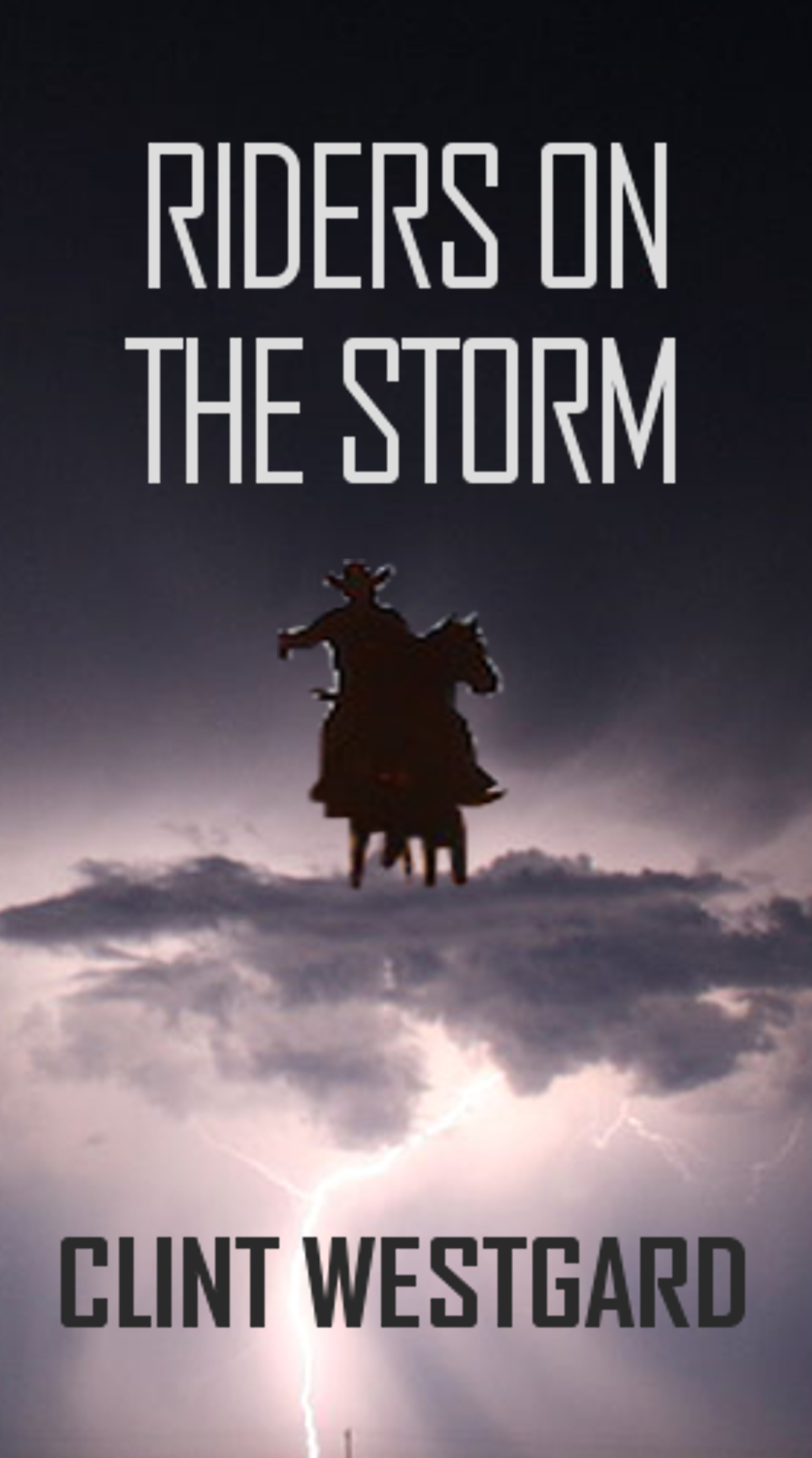
Now Available: Riders on the Storm

RIDERS ON THE STORM

A WESTERN

CLINT WESTGARD

The plan is simple, the reward large. It should go off without a hitch. But nothing is ever easy in the Rockies.

The MacAllisters gone for Calgary, their ranch hands in town drinking, and their cattle unattended seems the perfect opportunity for Amos, Wright and H.S. to seize. Just round up the cattle and make a quick run for the border before anyone is the wiser.

Instead they encounter trouble at every turn and now a vicious thunderstorm comes riding in, just as night begins to fall. Worse, it seems the ranch was not quite so abandoned as they believed…

Buy the ebook

riders

Now Available: All Down The Line

ALL DOWN THE LINE

A THRILLER

CLINT WESTGARD

Five men arrive to bargain in the dead of night at a bar in a small town on the edge of nowhere.

Each man has his own agenda. And each thinks he is in control, playing the others for his own gain. But when one of them is killed, all bets are off.

For the killer is among them and he is playing for keeps. In the end, everyone will pay, all down the line.

The story of a deal gone terribly wrong.

Buy the ebook

all-down-high-resolution

Excerpt: Riders On The Storm

In advance of the publication of Riders On The Storm on March 30, here is a short excerpt:

1

THEY HAD JUST entered the long and narrow draw past Sounding Creek when the storm hit. It had been threatening from the moment they left MacAllister’s, the sky filled with brooding clouds that seemed even more ominous in the last light of the day. Seeing them, they hurried to reach the valley, in the hopes that it would provide some cover for both them and the cattle they were trailing.

At the very least, Amos thought, as the rain began to spatter his duster, it would keep them from scattering everywhere once the winds and the rain truly hit. Nothing had gone as expected to this point though, and the encroaching darkness and the storm promised only more misery.

If he were a superstitious man, Amos might have thought the omens were against them from the start. Coming down to MacAllister’s from the north, where the three of them holed up for two days in Davenport’s old sod shack, getting in each others’ way and on each others’ nerves, they came across a dead cow lying abandoned in the scrub. The coyotes and crows had already been at it for at least a day, the smell of it so putrid the horses shied away. Amos stopped to study it for a moment, out of curiosity more than anything, while Wright and H.S. continued on. There was no evident signs as to the cause of the animal’s death, which was not out of ordinary in any way, but he still found it disconcerting for some reason.

The next problem came when they arrived at MacAllister’s ranch. The cattle were not around Gillespie’s Lake, as H.S. had said they would be, but spread out in the surrounding hills. It would take hours to round them up with just the three of them, though the hills would offer them some cover from anyone who happened to be passing by. H.S. had assured them that was extremely unlikely, with MacAllisters gone to Calgary and their hands all in Lethbridge for a day of drinking and whoring.

There was nothing else for it, other than abandoning the job entirely, but to set to work at rounding the herd up as best they could. They split up and went into the hills, thick with brush and trees. Both horses and men were soon in a lather as the cattle ran them across the countryside. Their swears echoed through the air, which might have been a concern, but they saw no sign of anyone.

It was well into the afternoon by the time they had the herd mostly together and heading out of hills toward the ranch. There they encountered their next challenge, for both the cattle and the horses wanted to stop at the lake to drink.

“Just let them,” Amos said as Wright whipped at the cattle, who ignored him, plunging their heads into the water. “They’ll go better if we just let them.”

Reluctantly the others agreed and they had lunch by the lake in full view of the ranch house and the shacks where the hands lived. It was disconcerting to say the least, and Amos found himself unable to look away from the yard, expecting at any moment to see someone coming toward them, rifle in tow.

“Ain’t nobody there man,” H.S. said, following his gaze. “I told you. They’re all off in town. Nothing to worry about.”

Amos nodded, though he did not feel reassured. Wouldn’t they leave somebody behind just to keep an eye on things? To stop the very thing they were attempting to do. Evidently not for, except for the cattle and birds circling and crying around the lake, the day was quiet and nothing stirred at the ranch.

When they were through with lunch they got back on their horses and got the cattle moving again, past the lake and south beyond the ranch. After their rest and water the animals moved easily, settling into a comfortable walk. The three riders all relaxed in their saddles, enjoying the warmth of the afternoon sun.

Amos, though, could not resist a final look back at the ranch. As he stared into the distance he was certain he saw movement beside the ranch house. There and then gone. He stopped his horse to watch for a moment, waiting to see if whatever he had seen would reappear. All was quiet and at a call from Wright he turned his horse around and returned to the herd.

2

WHAT REMAINED of the day passed without event, but because of the problems they had encountered in the morning they were well behind schedule if they wanted to be across the border before morning. That would be impossible now. Worse, the most difficult portion of their journey remained and they would have to complete it in darkness, for the sun was setting quickly now, the light going from the day even faster with the storm gathering overhead.

The draw was hard to navigate in daylight and with the added complications of trailing the cattle and the night, it would be even more perilous. Amos did not think about that now, pressing his hat down more firmly upon his head as the drops began to spatter on them. The wind began to gust as well, almost knocking the horses sideways as they picked their way down into the draw.

Amos felt the urge to hurry the horses and cattle ahead of them on into the draw where they might find a bit of shelter, but he knew it would foolish to go faster than they already were. A flash of lightning sparked to the south and west, illuminating the cattle in spectral colors, followed a short time later by the low rumble of the thunder. That seemed to be a signal of some sort, for the rain began to come in torrents only moments and the wind howled as though possessed by spirits.

The air itself felt charged and wild, as though the storm clouds above were about to spill below and engulf them. The animals were disconcerted by it, Amos’ horse jumping about as though there were rattlesnakes at his feet.

“God damn,” he said and spurred the horse up to join H.S. who was staring up into the rain at the clouds.

“I hope to hell there’s no hail in this,” H.S. said to him.

“You think we should stay here in the draw?” Amos said, turning his horse about so that he was looking back the way they had come. “Wait out the storm.”

H.S. shrugged, “Could be an idea. Cattle might be easier to handle if we keep them down here. Don’t know if we can though.”

Amos was about to reply when a bolt of lightning illuminated the sky around them. He waited a moment for the thunder that was to follow, so that he would not have to shout over it along with the rain and wind. As he did so, he glanced from H.S. up the trail to where they had entered the draw and was certain he could see the form of a man in amidst the shadows there. In the instant that he saw the form there was another lightning strike, blindingly bright and nearby, the thunder following atop it almost instantaneously. By the time he opened his eyes again, blinking furiously against the sting from the flash, nothing was visible but the coalescing shadows.

“What is it?” H.S. shouted at him.

Amos shook his head and slapped his horse on the haunch, starting back up the draw. The trail they were on was already a muddy, slippery mess and the horse had to pick its way carefully up the, now precarious, incline. The wind blew the rain directly into his face so that it was impossible to see more than a few feet in front of the horse. When he arrived at the spot where he was certain he had seen the man standing there was no one there, nor was there anyone that he could see in amongst the shrub and trees that dotted the trail. He leaned down from the horse to inspect the ground and could make out a variety of hoof prints, no doubt from their own passage, but nothing else.

He shook his head and returned down the trail, muttering to himself under his breath.

“Seeing things?” H.S. shouted at him when he grew near.

“I guess so,” Amos said, telling himself it had just been the play of the shadows in the heavy dusk which, with the hour and the clouds swallowing the sky entire, had now turned to utter darkness. The black was leavened only by the flashes of lightning, which illuminated the valley for the briefest of instants as they flickered across the clouds or to the ground. He pushed it from his thoughts, dwelling now on the growing heaviness of his duster and the spreading damp he could feel beneath. It was going to be a long night after a hard day, but if they could get the cattle across the border it would be well worth it.

The cattle, he could see, had reached the bottom of the draw, where it opened up allowing them to spread out off the trail, which they did immediately, heading for the sparse groupings of trees that littered the valley floor. It was the only shelter available to them and they clung to it as the storm continued to intensify. The three cowboys hunched together under few nearby trees as well, though it only provided meager cover from the rain and wind. They leaned in close to each other so they could hear the others as they yelled over the rumble of the storm.

“I think we gotta keep pushing them on,” Wright said. “If not we could spend hours trying to get them out of these trees in the dark.”

“They won’t wanna go,”Amos said.

“They won’t wanna go no matter what in this weather. But if we don’t go now we might still be here come morning. Don’t want that.”

Reluctantly, both Amos and H.S. agreed and, after a few more stolen moments of respite beneath the trees, they split up and went to start the cattle out of the draw. Amos went to the eastern end of the valley, letting the horse pick his way around the buckbrush, as he headed to where a group of five cows with their calves was huddled against the slender trunks of the trees there. The animals were even more reluctant to stray from cover than he had been, so he nearly yelled himself hoarse by the time he had the group started south again.

He slowly picked his way back to the trail as he found where some of the other cows had gathered and forced them on their way. He could see Wright just to the west doing the same each time the storm lit up the sky, but H.S. was too far off into the darkness for the lightning to pierce. The storm was almost directly overhead, the thunder now announcing the lightning bursts, which were so close they felt as though they were scalding his eyes.

Wright stayed to trail the cattle they had started back along the path, while Amos went to help H.S. with those that remained. There had to be another twenty cows with calves left to gather and he had seen no sign of them or of H.S., which was strange, given how narrow the draw was and how bright it became with each blast of lightning. The cattle he found easily enough. They were all huddled together in the largest stand of trees to the west of the trail and they refused to move when he came at them with the horse. He tried yelling, clapping and waving his hands and snapping the reins of the horse, but all his sound and fury was easily drowned out by the surrounding storm.

Giving up at last he descended from his horse and plunged into the trees on foot, waving and slapping at the cattle, sending them out scattering to the south. He nearly lost his horse as the cattle leapt from his path, some combination of the storm, the darting cattle and his own flailing startling the nervous creature. When he had calmed it and climbed back on, he rode around the trees to ensure that there were no cattle left and then turned to see what had become of H.S.

Riders On The Storm is now available for preorder:
Buy the ebook

riders

Excerpt: All Down The Line

In advance of the publication of All Down The Line on March 23, here is a short excerpt:

The first car, a blue Corsica with peeling paint that was gradually turning it silver, came from the west on Highway Nine. When he reached the turnoff for Hubbard, the driver pulled off the highway and rolled slowly past the ruins of an old gas station and down the main street, such as it was, to the far end of town where a hotel stood at the corner illuminated by one of the hamlet’s two streetlights. The other they had just driven past, stationed by the Community Hall, a stolid and square white building behind which sat the town’s ball diamonds. There were only a handful other buildings to speak of in the place—even the elevators had been torn down years ago—and only a few of those appeared to be inhabited.

There were no lights on in any of the windows they drove by—hardly surprising, given the hour. Even the hotel was dark, with no vehicles parked in front of it. That too was unremarkable, for it had been years since a room had been rented. Even the strippers passing through to perform made the drive to Loverna for better accommodation. The bar still did a regular business, somehow, mostly the local drunks who couldn’t be bothered with an extra half hour of driving to find more pleasant climes.

The Corsica pulled up in front of the hotel, under the streetlight and the driver turned the engine off and the lights as well. Nobody emerged from the car, though there were two people with the driver. They all sat in silence, waiting, looking at the broken and stained stucco that covered the hotel. The driver rolled down his window to let in the cool night air and they listened to the hissing and whirring of various insects.

They didn’t have long to wait. The second car arrived five minutes later, coming from the east on one of the gravel roads south of town. The three men in the Corsica could hear its approach, the distinctive grind of car wheels on gravel, long before it arrived and each of them began to shift in their seats in anticipation. The approaching vehicle, a Dodge half-ton, crossed the railroad track and turned onto a road running parallel to it that intersected with main street and the hotel.

The truck engine pulled up alongside the Corsica and cut its engine. Everyone emerged from their vehicles to gather at the steps of the hotel and shake hands.

“Ed. Misty,” the Corsica driver said, nodding at both of them. “You know Shane and Burscht.”

“Of course,” Ed said. “Good to see you Randall. You haven’t tried to wake Eduardo up?”

Randall shook his head. “We just got here.”

“I’ll see if I can get him up,” Misty said. He had earned the name when a stripper, of that nom de plum, had managed to take all his casino winnings one drunken evening, along with his clothes, boots and hat.

He strode up the steps to the door and hammered his fist against its heavy steel. When there was no response he repeated the tactic, cocking his head against the door to listen for any sound within. He turned to the others and shook his head.

“For fuck sakes,” Randall said, going halfway up the steps and craning his neck above to where a window on the second floor overlooked them. “Wake the fuck up, you lazy fucking half-breed Chinese.”

“You trying to rouse the village?” Ed said, something like a grin on his face.

“This fucking guy,” Randall said, shaking his head. “Every fucking time. He knows we’re coming. He can’t stay up or set a goddamn alarm?”

“It is aggravating,” Misty said.

“You get that from the dictionary?” Burscht said, bouncing back and forth on his heels.

Misty clenched his fists and came down the steps to where Burscht and Shane stood.

“Hey, hey,” Randall said, holding out a hand to forestall him. “None of that now. We’re all friends here.”

Misty turned to Ed who nodded curtly, but his eyes were leveled at Burscht and they were cold.

Randall turned to Burscht. “Hey, I’m already dealing with one dummy,” he said, gesturing up to where Eduardo remained asleep. “Now I gotta worry about you running your mouth? We’re trying to conduct a simple business transaction here. Let’s not make this more complicated than it fucking is. Alright?”

He looked from face to face and everyone slowly nodded. “Okay then. How do we get this useless fucker up?”

“Maybe try the door first,” Shane said, with a shrug.

Everyone watched as Misty clicked down the handle and pulled. The door swung open and they all walked in.

“We could walk away with the whole inventory and he’d never wake up,” Ed said, shaking his head in amazement.

“I wish I could say I’m surprised,” Randall said. “Go roust the pigfucker and don’t be gentle about it.”

Burscht went upstairs, while Shane ducked behind the bar to grab them all beers. The rest sat down at the largest table, looking around the room. It was a sight to behold, cluttered with tables and mismatched chairs in various states of disrepair, all thirty years old at least. Off beside the bar, Eduardo had set up a little kitchen on one table, with a hot plate and microwave. Surrounding them on the table were scattered plates and bowls, well-encrusted with food.

“This place smells worse every time I come here,” Ed said, lifting his head to scent the air, which was redolent with mildew and ancient carpet, cigarette smoke and urine.

“We’re just damn lucky no inspector gives a shit. They’d condemn this place straight out,” Shane said, bringing the beers over for everyone.

From above they heard a cry of pain that was quickly silenced, followed by Burscht’s angry voice. A few moments later Eduardo emerged, stumbling down the stairs bleary eyed and clutching his nose which was bleeding. Burscht came behind him, a laconic grin on his face, the look of a child who knows he has pleased his father. He led Eduardo to the chair, which Shane pushed out for him, and shoved him down to sit between the two opposing sides, before going to lean against the bar.

“Don’t tell me you forgot we were coming again?” Randall said. “Or did your alarm not go off this time?”

“That guy broke my nose,” Eduardo said, his voice muffled by his hands.

“Be glad that’s the only thing he broke,” Randall said, but he gestured to Burscht, who brought a damp cloth over from the bar. Eduardo pressed it to his face to staunch the flow of blood and put his head back so his nose was elevated.

“Now, maybe this is too goddamn complex for your Chinese brain—”

“I’m Filipino, man.”

“—but you have one fucking job in this whole enterprise. And that is to be awake when the fucking delivery comes. When you’re not, when we have to wake the whole fucking town up just to get a sit down with you, it jeopardizes the whole operation. Not to mention, it makes me look like a shitheel to our friends here.”

Randall gestured to Ed and Misty, who sat, staring stonefaced at Eduardo.

“Man, I been asleep like twice when you guys come.”

“You’ve been asleep every time Misty’s come by,” Ed said. “Don’t fucking lie.”

Eduardo gave a half shrug of his shoulders and fell silent.

Randall looked at Ed and shook his head apologetically. “Look, Eduardo, like I said, you got one fucking job here. And it’s not to keep this bar running. It’s to be awake when Misty comes in with the product. Or when we come in with the money. Or when, like tonight, we need to have a meeting to discuss your fucking incompetence.”

“Maybe we need to find someone else to take over the bar?” Shane ventured, trying to put something like a threat in his voice.

“Who the fuck else would choose to live here?” Misty said, looking around.

“That is a valid question,” Randall said. “But not relevant at the moment.”

“I don’t know, that picture really brings the place together,” Shane said, nodding toward the mural that covered one wall of the bar. It depicted an idyllic scene of a prairie lake of people swimming and picnicking along the shoreline. In front of the mural, which looked as faded as everything else in the place, a stage had been built with a stripper pole at its center.

“You don’t have any girls for us either,” Burscht said from the bar, drawing a glare from Randall, which froze his smile.

“Girls don’t come out anymore. Nobody comes anymore,” Eduardo said. “People are wondering why I’m even open.”

Randall and Ed looked at each other. “Are people asking you that?” Ed said, an edge to his voice.

“Sure. Guys at the mailboxes joke about it. Even the assholes that come in here everyday wonder about it.”

“Now see,” Randall said, leaning forward and grabbing Eduardo’s shoulder to pull him close. “This is why we need you awake when we come. Because if people start asking those questions and then they see us showing up at one in the morning, they’re going to start thinking we’re the answer.”

“Right. Sure.”

Randall was about to say something more, but he thought better of it and Ed spoke instead, addressing his counterpart. “This is what I am talking about. We’ve attracted too much attention here, and it’s going to bite us in the ass at some point.”

“I don’t think so,” Shane said. “This place has been open for years with nobody coming. Eduardo’s not the first moron these people have seen coming in and trying to start something here. They won’t be surprised he’s here. And they won’t be surprised if he decides to go.”

“You sure about that,” Ed said, and Shane nodded. “Alright, I guess we can live with this arrangement for now. Provided he’s awake when fucking deliveries happen.”

“Leave that to me,” Randall said and turned to Eduardo. “Get the fuck out of here.”

Eduardo stumbled from his chair and went back upstairs, still clutching his nose with the cloth. The others watched him go and then listened as the stairs creaked and the floor above them groaned with his weight.

When it was quiet above, Ed leaned across the table. “Now, let’s discuss our other problem.”

All Down The Line is available for preorder:
Buy the ebook
all-down-high-resolution

Now Available: Stand By Your Man

STAND BY YOUR MAN

A THRILLER

CLINT WESTGARD

Tammy Fairchild left Loverna to escape her reputation and make a new life in a new town. But problems seem to follow her wherever she goes.

Starting over, she finds herself a new job and a new man, someone she can trust. For Kevin Burscht is not like the other men she’s known. He is caring and considerate.

But not everything is as it seems with Kevin. He has a mysterious past filled with dark secrets. And Tammy finds that she is the one who will pay the price for his wrongs…

Buy the ebook

stand-by-high-resolution

In A Flash: On Down The Road

“Thanks for coming Cliff,” Walter said as they both climbed into the pickup, the dog nestling at Cliff’s feet.

Cliff nodded, but did not reply. The day was hot and the truck, which had been sitting out in the sun, was hotter and his back was already damp with sweat. He rolled down the window and rested his arm gingerly against the scalding hot metal. The dog looked up grinning at him, in spite of the uncomfortable position it had contorted itself into.

Walter rolled down his own window and started the truck, humming to himself as he did. The radio, as always was tuned to 770, the talk radio station from Edmonton. In afternoon’s, which it was now, Rutherford was on. Cliff found him insufferable. Walter did too, but he enjoyed listening to him. Enjoyed disagreeing and getting annoyed and laughing at how wrong he was.

Walter headed out to the road and turned north, the dust from the gravel leaving a broad wake behind them. It had been a dry year, the pastures were already more brown than green, and the green of the fields was fast turning to yellow. Harvest would be only a couple of weeks away, or sooner, if the warm weather held. It would be a poor one as well—there had been little rain that spring and none in the summer. Walter said it was as bad as he had seen it, as bad as when he was a kid in the thirties.

“I just don’t feel comfortable heading up to the pastures by myself anymore,” Walter said, as if the silence of the last minutes had not happened. “Not as young as I used to be. Of course, before I would’ve taken Jane.”

Cliff opened his mouth but did not reply. He didn’t know quite what to say, didn’t have the words. Jane had been Walter’s wife for over fifty five years. She had died the summer before, a summer as hot and dry as this one.

Clliff didn’t have to say anything though. Walter kept talking, as he drove down the road at an ambling pace.

“That calf is probably dead, but we have to go see if we can find it. Might’ve just gotten separated from its mother. I remember we had a heifer, got her head stuck between the branches of a tree and couldn’t figure out how to get out. Almost died before we found her.”

Cliff nodded. He had heard the story before, as he had heard so many of his grandfather’s stories. In spite of the open windows on the truck, it still felt stultifying. Or perhaps it was just the same old conversations, the same old trips down the same old roads. That fall he would be off to university. He was counting the days until he would be free of this tedium. Life felt as though it were happening somewhere else, while he chased after presumably dead calves in pastures somewhere off in the middle of nowhere.

Read the rest at Circumambient Scenery.

In A Flash: read a new story every Thursday…

If you like this story, or any of my others, please consider supporting me on Patreon

Image Credit

In A Flash: The Adventures of Holly and Morris

They hit the payroll, catching them in a crossfire as they came into Horseshoe Canyon on their way to pay the miners at the Atlas Coal Mine in Wayne. There were only two guns protecting it and Morris and Holly picked one off each from their perches across the canyon. The two men leading the packhorses tried to flee, but they shot the horses out from under them and then had to scramble to their own mounts to catch up with the fleeing payroll. That they did, intercepting the stampeding horses before they could scamper up the narrow and winding trail that led from the canyon to the plains above.

When they had calmed the panicked animals they left the canyon behind, heading up into the hills to the north where they had a camp set up. There they watered the horses and set them loose to eat and counted their day’s earnings. They were giddy as they went through the coins and the well-creased bills, over two hundred fifty dollars worth. They could sell the two pack horses too and probably get close to three hundred when it was all said and done. Holly whooped and danced, kissing Morris and pulling at his beard.

He laughed in joy at her delight. “No more worries for awhile, Holly dear.”

“No more worries, Morris honey,” she said and pulled him to his feet to join in her dance.

Read the rest at Circumambient Scenery.

In A Flash: read a new story every Thursday…

If you like this story, or any of my others, please consider supporting me on Patreon

Image Credit

In A Flash: Gambler’s Fallacy

The ripple of the cards upon the table, the shifting of everyone upon their chairs, the thumbing of glasses and clothes, the shuffle of money and hands: Burgess can hear it all. His eyes are closed and there is thunder in his mind, but he can hear it all. The air is redolent with the stench of rotgut whiskey, sweat and the wood burning in the stove they are all huddled near to keep out the winter cold.

Burgess opens his eyes at the sound of the door opening and sees Pederson returning within from the outhouse. A gust of frigid air makes them all tremble. Pederson takes off his coat, his breath still staining the air in clouds around his head. Everyone watches as he returns to the table and picks up the deck.

“Sorry boys,” he says with a smile. “Where were we? Five card draw?”

There are grunts of assent and the cards go out. Burgess does not touch his until they are all dealt, his eyes intent upon Pederson’s hands. His face feels hot in spite of the chill in the room, and his gaze goes blurry and then steady with each blink of his eyes. There is the sound of the ocean in his ears as someone stands to refill the glasses and someone else asks a question about Maggie Garneau. He thinks about saying something witty, but decides not.

The cards are dealt and he looks at them. Trip fives. He looks around the table. Everyone is looking at their cards. The bet comes to him and he throws in five dollars.

“Spending all your winter funds,” Pederson says, not glancing up from his cards.

Burgess bristles. “We’ll see where I stand at the end of the night.”

“You’ll be standing because you’ll have nowhere to sit again.”

Read the rest at Circumambient Scenery.

In A Flash: read a new story every Thursday…

If you like this story, or any of my others, please consider supporting me on Patreon

Image Credit

The Falkenbourg Place

There were several hired men who passed through the Faulkenbourg Place in the following years. None of them stayed for long, though none admitted to feeling any odd sensations while living in the house. It was the nature of job that there would be so much overturn, at least that was what David’s father told him. At the same time the farm prospered and, along with the rest of their neighbors, their family had money to spend. They put electricity and plumbing in the house not long after, removing the last vestiges of its homesteader roots.

What truly marked the passage of time though was the worsening of his mother’s condition. There was the day when she ceased to rise to see he and Eric off in the morning, the day when his father started to make their suppers after he came in from work, the day when she could no longer walk without help, and, worst of all, the day when he had to keep score in their nightly game of gin rummy. Though it was never said by anyone, David understand that these were the way stations on the path to oblivion, that his mother was dying, as Albert Faulkenbourg had died, as the steers did when they were sent to market in the fall.

Death did not seem a strange occurrence to him, not when he was surrounded by it daily. He assisted in killing the hens and pigs when the time came each year and had spent many an afternoon watching hawks lazily circling the sky above a tractor as it moved through the field, stirring up the mice and voles below. This, he understood, was a different kind of death, a momentous one, the others merely profane. It wasn’t the fact of the death that told him this, dying seemed much the same regardless of who or what was doing it, it was everyone else’s reactions to it.

Visitors that came to the farm, even the various hired men, would speak in hushed tones or with a forced joviality when his mother was about, her condition obvious at a glance. They would not meet her eyes and then stare at her when they thought she wasn’t looking. David suspected she noticed it all, though she never said. His father, taciturn by nature, turned ever more inward as his mother’s condition worsened, some days speaking no more than a dozen words. Eric, too, retreated within himself, passing his hours at home in his room, not even spending time with David. He was hurt by this change in his brother, for in their younger days they had been inseparable.

Unlike the others, David was drawn to his mother, spending as much time as he could with her. He became the one who unfailingly helped her around the house as that became more difficult. He found reasons to be near her, to touch her, crawling into her lap to sit, though she found such contact painful in her condition. His father would yell at him to leave her be when he would see him sitting in her arms and he would slink away, only to return later as soon as his father had gone away. The smell of her fascinated him, musty and rank, as though an unseen decay had already begun within her. As the end neared and she spent more and more time in bed, neither sleeping nor truly awake, David would secrete himself in the hall outside her bedroom and stay for hours listening to her labored breathing.

He was fourteen when death granted her the peace life had not. Just as her illness had changed and reordered the cosmos of the farm, so her passing did again. His father withdrew ever more inward, working blindly in the fields, and in the evenings retreating to his office or to shop, where he would tinker mindlessly on some project or another. It fell to Eric to take care of them, once the neighboring wives stopped bringing over meals they had prepared, getting David up in the morning for school, helping him with his lunch and making supper for them when they got home. It was a role he resented for the burden it placed upon him, and yet fiercely protected whenever David would try to care for himself.

For his part, David felt lost in this new world, so he avoided both his father and brother as much as he could. He would wander among the three rows of trees, evergreens and caraganas, which divided the farm from the road, playing in imagined realms in the shade of the branches. Days when he knew the farm hand was out working or in town, he would take his bike and ride the mile to the Faulkenbourg Place, sitting in one of the rooms on the floor, staring off into nothing. In those long hours he felt it speak to him, its soundless reverberations echoing through the center of his being.

Even as he turned fifteen and started high school, a time when he knew he should have moved beyond these childish things, he continued to venture to the house, its very presence reassuring him. One Sunday, with his father and brother having retreated into their respective worlds and the farm hand gone home for the weekend, he went over to pass the dreary afternoon. He stayed for hours, losing track of time, watching the sun move through the sky by the changing light coming through the windows. Though he knew he should leave, that the farm hand would be returning soon, he could not bring himself to stir from his reverie, until he heard the truck wheels on the driveway.

In an instant he was on his feet, sweat on his forehead and panic in his mind. He stayed frozen for a moment, unsure of what to do, knowing only that he couldn’t go out the front door without being seen. The windows were no good either. He would need time to get their screens off and their being open would be evidence enough of his presence. Had he been a little older and a little more confident he might have met Grant at the door with an apology and some excuse – no butter in the house – which he would likely have accepted without question.

Unable to think of anything else, he fled to the bathroom, climbing into the tub and ducking down so that his head did not peek over the side. This proved to be a poor hiding place, for after the long drive from Bonneyville, the first thing the farm hand did was go to the bathroom. He had his fly unzipped before he noticed David.

“Goddamn Christ,” he said with a jump. For a terrifying moment David thought he was going to hit him. Instead he walked out without saying another word. David could hear him on the phone to his father. He stayed where he was, letting the disaster continue to unfold, knowing that Grant was on the other side of the door if he tried to leave.

In a few minutes he heard another truck pulling into the yard and the front door opening, the screen door clanging against the side of the house. No words passed between the two men and then his father was there, looming above where he lay crouched miserably in the tub. His father leaned down and cuffed him hard on the ear, the other side of his head hitting sharply against the tub. Without needing to be told David got up and followed him out, past Grant whose eyes he could not meet, and then home, neither of them speaking.

from Smeagol Blues

Available in the collection On the Far Horizon

Protocols

The wind did not begin to subside until late the next evening and it was not until the following morning that they awoke to a day glorious and calm. He had work to do around the yard in the morning, chores and repairs on one of the tractors, so it was only after lunch that he left, telling Emma that he was going up to check on the water at the lease. The dugout there had been low the day the object had been taken and there had been no rain since.

Though Emma had given him a look as though she suspected he were up to something, he had no intention of confronting the Concern about the object. He had thought about it the night after their argument and throughout the next day and had decided against it. He knew Emma well enough to understand which of her threats she would make good on. Stubborn as he was, even he could recognize that the object was not something that was worth risking his marriage.

The aftereffects of the storm were evident everywhere as he drove north. Ditches were filled with drifts of a fine powdery earth, almost like sand and several of his neighbors’ yards had trees that had been uprooted. There was a grain bin lying crumpled and warped atop Werner’s hill, an amazing site, for the nearest bins that could have been carried here were at Barthels, over two miles away. None of the power lines were damaged, as far as he could see, which told him that it had been blown high enough to clear them. The fences along the road were all filled with detritus, anything that hadn’t been weighted down had been scattered across the country.

The dugout in the lease was as low as he could remember it being. Two cows were standing right at its center with water up to their waists when he drove up. Unless it rained in the next few days he would be trucking water up here by next week. He swore to himself thinking of how much time that would take. Three quarters of an hour each way, with half an hour to fill up the water tank. Two trips every other day. That would be three mornings gone a week at least, to say nothing of Tommy’s pasture, which he would be hauling water to soon enough as well.

He was about to head home, his head filled with worry for what the rest of the summer would bring, when the ground where the object had been caught his eye. The grass had not recovered at all, had in fact turned a brittle shade of brown. It cracked underneath his feet as he walked across it, and each step was marked with the outlines of footprints. He could feel the color go from his face and he crouched down, as much to steady himself as to inspect the grass. He prodded the individual strands delicately with his fingers and they crumbled to dust at his touch. Cursing under his breath, he pulled the knife from the front pocket of his jeans and dug into the ground to expose the roots below. They too were utterly desiccated.

He said nothing when he returned home for supper, though he could feel Emma’s watchful eye upon him. They went to bed wordless and he again found himself staring at the ceiling waiting for sleep to steal him from his thoughts. That night it would not though. Try as he might he could not forget the ruined, brown patch. Would anything grow there again? And was the object having the same unseen effect upon him even as he lay there? It was a terrifying thought to say the least.

The next morning he awoke tired and with an aching head. His jaw had been clenched tight through his fitful sleep, his anger not dissipating, even through his tumultuous dreams. He drank his coffee and had his porridge in silence, Emma watching him as she ate her toast. When he was done he pushed aside his plate and his cup and stared at her. Their eyes held for a moment and then she closed her eyes, warding herself for a blow.

“I’m going to the Concern today. That fucking thing killed a bunch of grass up in the lease. They’re going to have pay for it.”

Emma offered no reply, her face impassive, as he left the house, letting the door slam in his wake.

He went into town after he was finished with the chores, getting some parts at the Agro Centre. On his way back he turned off the highway and headed down the road to the Baas. The three long barns loomed up before him, still the same white they had been when the Dutch company had been running pigs there. A chain link fence surrounded the yard now, which also had a dozen or so trailers near its entrance that acted as offices for the Concern employees. The trailers formed a sort of informal blockade between the gate and the barns where the research was done. There was also a small hut at the entrance where everyone had to check in before being allowed into the compound and Frank stopped there, asking to speak with Hildeck. He was sent to the largest trailer where he found the manager and a young woman he did not recognize.

“Frank, this is Katy Miles. She’s actually working on the project that, uh, you encountered,” Hildeck said as he motioned for him to sit.

Frank stared at her fiercely, derision and rage written plainly on his face, so that Hildeck cleared his throat and motioned for her to leave, which she did, her face flooding with relief. “What can I do for you Frank?”

“That fucking project of yours is killing my grass.”

David frowned and leaned forward. “How do you mean?”

“Where it was, all the grass is dead. The roots are dead. It’s not coming back.”

“Well,” Hildeck said, leaning back in his chair, “That is strange.”

“That’s one goddamn word for it alright,” Frank said. “I touched the thing. What the hell is it going to do to me?”

David started up, as though he had been awoken from his thoughts, and waved his hand. “Oh, it’s been fully tested. We have people working with it all the time. No long term effects have been observed.”

“I bet.”

“I wonder if we could get a look at that grass though. It might help the team get a handle on what happened there.”

Frank smirked and took off his ballcap, running a hand through his hair. “You don’t have a clue what happened do you?”

“Well, I certainly don’t. It’s a little outside my expertise.”

“Not a clue at all,” Frank continued, ignoring Hildeck. “You know what the thing is supposed to do?”

“I’m afraid I can’t really discuss that, you understand. We have certain security protocols,” Hildeck said, shifting uncomfortably in his chair. “Now, to get back to your pasture, we’d certainly like to get a look at that. Can we discuss getting access? We’ll gladly pay of course.”

“I know you will.”

David cleared his throat. “Well then. I’m sure we can come to some sort of agreement.”

“I’d like to see the thing again.”

“The prototype?”

“Yes,” Frank said leaning forward in his chair for emphasis.

“I’m afraid that’s impossible. We have protocols and I don’t think I can get permission. We’ll gladly pay our standard access fees. And of course for the damage the prototype did.”

Frank did not reply, standing up and walking out the door, leaving Hildeck to stare after him in disbelief. He got in his truck, spinning out as he turned around to head back out to the road, slinging gravel across the yard. He flew home, pushing the needle to 160 kilometers, oblivious of the other traffic on the highway. The radio was on but he talked over it, cursing Hildeck and the Concern for stealing the object, and Jennings for letting them. It was clear to him now that they had no more idea of what the thing did than he.

When he pulled into the yard he saw that Emma’s car was gone. He sat in the truck for a moment unable to quite process what he was seeing and then ran inside, calling her name. There was no answer and as he looked through the living room he saw that all of Colton’s toys were gone. There was a note on the kitchen table that read: I’ve gone to Mom and Dad’s for a few days .I’ll call on Saturday and we can talk. He slumped into a chair holding the note up and looking at the words, not reading any of them.

from It Came From Above