Field Notes

Being a record of certain phenomena found in the environs of the Lost Quarter.

Red Ribbon

He first glimpsed the sister through the trees that surrounded the Faulkenbourg Place. Since moving there it had become his habit to walk between the rows, starting from the laneway that led to the road and ending when he had circumnavigated the property and returned to the other side of the lane. The yard itself was quite large with extensive pens for cattle, grain bins and storage sheds for equipment, all in various states of disrepair. Thistle and brome grass overgrew the lanes between the corrals and buildings. They grew between the trees too, but he quickly wore down a trail. He liked being among the trees, unable to see to the farthest horizon as seemed the case anywhere else he stood in these parts. There was a hush there, a quiet, as if he’d journeyed to another place.  

The wind was blowing – it was always blowing – bending the branches and fluttering the leaves, shifting things from light to shadow and back again. She was in the field just beyond the trees, passing through the stalks of wheat with a surprising grace, a red ribbon trailing from her hair. She didn’t seem to notice him, moving alongside the trees toward him. He called out to her, not wanting her to think he was lurking in the shadows with ill intent. The wind gusted, carrying his words away, and she didn’t hear and passed on her way.  

He saw her several more times, usually in the field beside the trees, though once at the far end of the row he was in. It seemed difficult to believe she could fail to notice his presence, but she never acknowledged him. She was young, maybe eighteen or so, and he assumed she was the daughter of one of the neighbours. When one of the brothers across the way asked how he was getting on, he mentioned his walks and how much he enjoyed them and added that there must be someone in his family who felt the same for he always saw her walking the trees. The brother could not hide his dismay at the statement and changed the subject. This piqued his interest and he began to ask around town about the Faulkenbourg Place. It seemed odd to him that the yard for what had obviously been an extensive operation had been allowed to fall into such a state. 

People were reluctant to speak on the matter. They would mutter something about the sisters and then talk of something else. It was very unlike the locals who seemed willing to gossip about anything, even with a stranger like him. It was only when he came across a story in an old newspaper while doing some unrelated research that he realized what they wouldn’t tell him. Hazel and Abigail, the McIntyre sisters had both loved Sven Faulkenbourg. He’d chosen the younger and in a fit of jealousy Hazel had murdered her sister, drowning her in a slough. At the time it was seen as a terrible accident and Sven had gone to Hazel for comfort while he mourned. One thing had led to another and soon they were to be married. 

They lived with Sven’s parents until they could build a place of their own, the very house he was renting. Sven discovered a red ribbon in Hazel’s things. There had been strands of red ribbon found under Abigail’s fingernails when she had been pulled from the slough. It had been noted at the time, but more as a curiosity. When Sven found the ribbon he understood what had happened and he strangled Hazel with it. He was hanged, one of the last to receive capital punishment in those parts and his parents moved away, unable to bear being in the house and on the land where such a tragedy had happened. 

Field Notes

Being a record of certain phenomena found in the environs of the Lost Quarter.

The Hermit of the Hills

Nels came to the Quarter with three others in the early years of the century trying his luck on a quarter section. The other three sent for their families after they had broken the land and thrown up a shack, later ordering homes from the Eaton’s catalogue when they had money from a couple of harvests and their second quarter was handed over. Even after he got his second quarter Nels continued in the same shack, building a more permanent structure only after his first decade on the land. Many of the neighbours said this was little better than the shack he had been living in, though it did at least have a wood floor and a cellar. 

Nels was always a friendly presence, happy to chat with anyone in town, available to help with harvest or any work really. His neighbours looked forward to his regular visits to spend an evening at cards and he called three or four families once a week. As more settlers arrived, people wondered when he would marry. Many of the other bachelors who came in those years did find wives, either among the locals or from their original homes. Nels did not though, never going with any of the local girls, even when others encouraged him to. After a time all that sort of talk stopped as people accepted things for what they were.  

He never left the Quarter after homesteading, not even during the ten years of drought when so many others abandoned their farms, some not even leaving word or a forwarding address. More left with the second great war, travelling to far-flung lands and more still in the years after. The automobile was coming in wide use then and highways were being built. There were new opportunities everywhere. The Quarter was somehow both larger and smaller as a result. Fewer homesteads dotted the landscape and the farms were getting larger, while it was now possible to travel across most of its length in the space of an afternoon.  

People saw less of Nels as the years went on. Several of the families he stopped in to play cards with had moved on after the war. Tractors and other machines meant that agriculture was no longer a communal activity, though he did still drive truck for a couple of neighbours. Folks started talking about him differently too, though he hadn’t changed much. He was a man of his era, a time now past, when people were willing to throw away the lives they had been living, leave it all behind and take a chance on a far away land with no guarantees. Everyone was settled now, knowing nothing else and of the place in a way that Nels, and those who had arrived with him, could never be.  

At some point people began calling him the Hermit of the Hills, though he was always about and his half section was not especially hilly. Older siblings told younger ones about the terrible things that would happen if you wandered onto his land or into his house, which hid a portal to another demon-filled world in the cellar. If Nels knew about these stories he never said. He got diabetes in his later years and one of his feet took an infection which he neglected. Doctors took the leg to try to save him, but it was too late.  

He willed his land to one of the neighbours, the son of one of the men he’d come out with. Nels had always called on them for visits, so the first time they set foot in his house was after he died. It was a ramshackle place, as to be expected given he’d built it himself. The yard was littered with old pieces of equipment collected in piles that they supposed had some sort of logic to them. None of that surprised them, but what filled the cellar and one wall of his shop did. Hundreds of urns and vases and bowls, made from scrap metal and whatever else Nels had at hand. They were all finely made, intricate designs carved or painted on them. Beautiful in their strange way. Of another world. 

Field Notes

Being a record of certain phenomena found in the environs of the Lost Quarter.

Passing Through

The wind stirred, bending the blades of grass, moving like an unceasing wave up the hill and down and up the next. A shadow moved behind it as a cloud drifted over the sun.  

The two dozen or so travellers below looked up thankfully at this brief respite from the unseasonable heat. They were heading north, following the trails bison had carved through the grass. Scouts were far ahead with an eye for trouble or game, while further back mothers supervised children and dogs pulling travois. There were jests and laughter and a lightness that comes with the promise of a bountiful season to come. They paused here and there to rest where the hills blocked the sun, but did not linger in this place. 

Later others passed by, now on horseback, flintlocks mixed in with bows and arrows. They moved like the wind, with it, carried to the farthest horizons. Clouds of dust marked their passage when it was hot and dry, as it was now.  

The wind gusted, knocking the grass flat to the ground. The clouds seemed to cluster above, stuck in the sky even though the wind was so fierce below, the sun barely glinting through. 

Others came and left, measuring out the land and marking it with rods they plunged into the earth. All around newcomers arrived, setting up houses and breaking up the land. Here the land was left untouched, no one willing to settle upon it. Not entirely though, for the settlers, seeking permanence that had never been in the nature of the land previously, planted trees in a futile attempt to hold back the wind. Seeds blew to this place and soon enough grew in low lying areas where the water gathered in spring. Short and bent things, huddled close to the land against the wind. 

Later barbed wire fence was strung up, following the surveyor markers, and cattle roamed, carving new paths. A watering hole was dug where the spring runoff naturally gathered. From spring to fall the cattle wandered from the dugout to the eastern spring, finding shade in the copses that dotted the lowlands between the hills. People never lingered, coming only to bring the cattle and collect them when it was time to move to fall grazing, checking occasionally throughout the summer. 

The wind howled and groaned, whistling through the trees with menace, dark clouds massing to the north with the promise of rain and thunder. Dust whipped through the air, clouds of it forming, dimming the sun. 

When it grew too dry more of the surrounding lands were seeded back to grass. Better that than to watch it all blow away. The cattle remained, but the wire was stripped from the fences and the posts dug out or left to rot. Drones operated keeping the various herds separated, moving them to fresh pasture when needed. Only in the spring and the fall, during the great roundups did anyone pass through again – one or two only – supervising the drones’ work.  

Later, travellers passed through again, usually when crocus flowers gave way to golden beans. Usually they were on foot, moving in groups of two or four. They went slowly, stopping to camp on occasion by the eastern spring that still ran true. The bison herds from an earlier rewilding were sometimes still in the hills if the spring had been late in coming, as it often was. At night, as the wind stirred in the grass chasing away the mosquitoes, they would lie back and look at the specks of light in the vast sky above moving on their circuits through the stars. 

Field Notes

Being a record of certain phenomena found in the environs of the Lost Quarter.

Notes on Certain Settlements in the Quarter

The Summer Camps: Before their exile to the north and east, under the terms of the Dominion treaties, both the Iron Confederacy and the Blackfoot Confederacy ranged across the Quarter, following the bison herds during the summer months and establishing regular camps. The arrival of horses to the territories increased tensions between the Confederacies, resulting in raids by band members on both sides to build their herds. This was exacerbated by the arrival of the Company in the area, allying with the Iron Confederacy to ensure access to the northern river system trade routes. With the loss of the bison herds and the steady encroachment of European settlers into the Quarter, the use of the camps was abandoned. The signing of the treaties ended their use entirely. 

Sybald (also Sybbald, Sebbald): A relatively late European settlement within the Quarter. New arrivals initially travelled south from Lakeview, the closest they could get by train. Within a decade a bustling community had developed, the largest in the area, and an important stop on the new train line. This initial fluorescence was followed by a long period of decline, precipitated by a fire that consumed half the town on the eve of the Great Depression. Many inhabitants left for the northern plains at the insistence of the provincial government. By the turn of the millennium less than ten inhabitants remained, though the surrounding farms still flourished. In later years the population remained relatively stable and it even regained its importance as a transit point during the disputes between the New Dominion and Greater Western Republic to the south. With the reestablishment of the Suffield Army Base as the key infantry base in the region, many of those living to the south moved north to ensure they fell within the perimeter of its drone defence system. 

Gloevers Crossing: As long as there have been people in the Quarter, the spring at Gloevers Crossing was a crossroads for travellers, due to the presence of a free-flowing spring. During the period of European settlement, the spring fed a large, shallow lake that locals flocked to on Sundays to swim. The lake gradually filled in becoming a pond surrounded by a small stand of trees. In more recent years with the continued depopulation of the region as people’s interest has shifted to the settlement of the stars, several wickiups have been established in the shelter of the trees by the spring. These are semi-permanent structures, occupied during the winter months by the O-Bannon Wanderers who migrate throughout the region. 

Field Notes

Being a record of certain phenomena found in the environs of the Lost Quarter.

Form and Function

There has been much written about the mourning boxes that inhabit so many homes in the Quarter, enough to fill several volumes, yet their innate mysteriousness persists. Even those who possess them and have some inkling as to their origin do not understand the meaning of the objects. They are merely heirlooms, passed down through the family, occupying a place of importance and display in everyone’s homes.  

What they are called, of course, seems to offer a tantalizing clue as to their origins and original purpose, and yet the one thing everyone is certain of with the regards to the boxes is that their name and origin are unrelated. In the Quarter, as elsewhere, the dead are buried in the earth or burned on pyres. Any ashes are placed in urns, not within the mourning boxes, which are always empty and cannot be opened. Aside from being passed down from generation to generation, the mourning boxes have no apparent connection with ancestors or the dead. So why the name? It must be in reference to something. 

The latest research offers a suggestion. Most mourning boxes, especially the oldest, are marked with engravings. These have historically been seen as mere decoration, though it has been noted that the engravings follow similar patterns within families and regions. This was assumed to be because the artisans who made the boxes had a particular style they followed, but it has also been frequently noted that they share certain commonalities with various runic alphabets. A recent comparative analysis of the engravings of 5000 mourning boxes noted a number of repeating motifs that they argued could represent letters. Most of these shapes are angular and there are few horizontal strokes, typical of early runic alphabets.  

Yet the individual runes, if that is what they in fact are, appear to have no connection to any known alphabets and it seems impossible that those coming to the Quarter would suddenly take up an alphabet centuries after their ancestors had abandoned it. In every other facet of their lives they utilized the latin script we are all familiar with, except in this one instance where people of the region used a now forgotten alphabet that had no connection to any used by any of their distant ancestors. Could some runic symbology have somehow passed hidden through the centuries, only to become visible in strange, purposeless boxes in a forgotten and forgettable region inhabited by so many disconnected peoples? 

It is the emptiness of the boxes that I always return to. They are all built hollow, with the form of containers, yet without the function. I am of the belief that the mourning boxes were built to contain something, contents that were never to be disturbed given they were sealed in their construction. Nothing has been discovered inside any of the boxes, but there are few remaining that are more than a century or two old, and by then the meaning of the boxes had already lost, forgotten like the letters that mark it. As with so much of the past, we have the maps to mark the territory, but that is not the same as walking the roads that once crossed there.

Now Available: The Adventures of Holly Amos

THE ADVENTURES OF HOLLY AMOS

A WESTERN

CLINT WESTGARD

Holly Amos is on the run from a payroll heist gone south. With Morris Danforth at her side, trouble has always been what she’s been searching for. But lately Morris has been more trouble than he’s worth, and Holly is thinking it’s time for a change. But with the law after them, things are about to take a turn for the worse.

Clive Hestin is the lawman on her trail. He is a Northwest Mounted Police constable, banished to a lawless frontier town for refusing to look the other way on the crimes of his fellow officers. Now he has to track down Holly and Morris or risk being drummed out of the force forever. Nothing will stop him from seeing justice done. Nothing except, perhaps, Holly Amos.

Buy the ebook


Now Available: On The Far Horizon

ON THE FAR HORIZON

WESTERN, CRIME, THRILLER

CLINT WESTGARD

Cattle rustlers on the run, caught between a storm and someone bent on revenge. Cowboys pursued by the law and their own demons through a long night. A dive bar in the middle of nowhere hosts five criminals for a deal that goes terribly wrong.

These and other stories explore the lives of those who populate the west. Homesteaders with mysterious pasts they’d prefer to keep hidden. Women wronged by the men they love and caught up in events beyond their control. There are killers, thieves, cops on the make, and people just trying to get through their days with their eyes On The Far Horizon.

All of these characters, and many others, meet in this pulse-pounding collection that will keep you at edge of your seat.

Buy the ebook

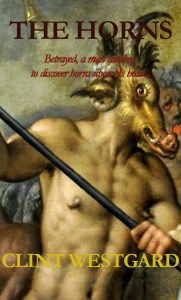
Excerpt: The Horns

In advance of the publication of The Horns on July 20, here is a short excerpt:

In the year 1625 of Our Lord, in Cartagena, that magnificent and redoubtable coastal fort in the Viceroyalty of Peru, Don Santiago Alvarez de Armias awoke one day to discover horns upon his head. They were long and narrow, curving slightly upward from his forehead, not unlike an goat’s. Or a demon’s, as his servants and slaves whispered to each other upon seeing it. Most of them fled his house in the days that followed, for they had a premonition of the trials that awaited him.

These began, if there is such a thing as beginnings and endings, the day prior, when Don Santiago met some acquaintances on the streets beyond the Plaza de los Coches, where he had come from looking at some slaves on offer at the market. The full heat of the day was upon them and they elected to retire to a nearby tavern to take some sustenance there. One of the men, a notorious cocksman named Armando Gonzago, told the other men a salacious tale of his latest conquest, who he had been with that very morning while Don Santiago was at the slave market. So tempestuous was their lovemaking, Armando claimed, that they broke the baluster on the bed. All three men laughed at the thought of the poor cuckold who would return home to a broken bed and his wife’s poor excuses. Which he would no doubt believe, for Armando noted he had been so oblivious to this point that he did not suspect anything was amiss.

The three men finished their oruja and said their goodbyes. Don Santiago went about the rest of his day, giving little thought to Armando’s tale. It was evening by the time he returned home. As he let one of his servants wash his face with a damp towel, his wife called out to him that he would need to see to the repair of their marriage bed, whose baluster had somehow become broken.

Don Santiago went still at her words. “How did it become broken?” he said.

I only noticed it this afternoon,” she said, as though that were an explanation.

As if in a dream, Don Santiago recalled other instances of her evasions from his questions, other times when she had offered no explanation for strange incidents and absences. An incredible anger began to build inside him. His whole body seemed to tremble, as though assailed by a tempest. Words failed him.

When he recovered himself somewhat he strode into the bedroom to investigate and saw that, indeed, the baluster had been snapped in half. He strove to peer through the dim mists of his memory to that very morning when he had risen from bed. How had the baluster appeared then? Solid and whole, just as the frame itself. Now here it lay upon the floor, as broken as his trust in everything his wife told him.

Don Santiago called her into the room, demanding that she explain herself.

I don’t know. It was fine this morning, but when I came in this afternoon I found it so. Perhaps,” and here she lowered her voice, so that only he could hear, “the servants were about where they should not have been.”

Don Santiago stared at her, numb and cold, all emotion having fled. He turned to look at the mestizo boy who attended him when he was at home, but the boy would not meet his gaze. A terrible shudder overcame him, as though a spirit had passed across his grave. He bent down to seize the offending piece of wood and turned back to his wife, who studied him with a bemused expression on her face.

His rage returned to him, overwhelming, coursing through his veins like a torrential river. He struck his wife with what remained of the baluster, knocking her stunned to the floor. A trickle of blood ran from her head down between her eyes. Blow after blow he rained down upon her, until she lay upon the floor in an ever-growing pool of blood.

Servants were screaming, footsteps sounding throughout the rest of the house. Don Santiago could not hear them over the thunder of the pulse in his ears. His head ached and he felt exhilarated beyond belief. He looked from his wife to the mestizo boy who remained standing, his lips quivering wordlessly, too afraid to move lest he draw his master’s ire.

The baluster was still in his hand and he tossed it to the floor beside his wife, gesturing to the boy. He would not come, still staring in mute horror.

Here boy,” Don Santiago said, “listen. Go summon the Alcalde quick.”

The servant would still not move and Don Santiago had to drag him from the room to send him on his way. When the boy was on gone, he turned back into the bedroom trying to gather what remained of his thoughts. The Alcalde would need clear evidence that his had been a righteous fury, justified by his wife making him a fool and a cuckold. As he pondered this, he looked upon the broken form of his wife and saw her mouth opening and closing oddly, as though she had lost all command of it. Her body writhed on the floor, as if she were in the throes of an awful ecstasy.

One of the other servants tried to come tend to her, but Don Santiago chased her away with the baluster, forbidding anyone else coming near in a voice that sounded tinged with madness. He sealed the door to their chambers and crouched beside his wife. As he stared into her dying eyes, he tried to think of something to say, a fitting closure to their lives together and her utter betrayal of his honor. But his wife surprised him by speaking before he could.

I curse you, Don Santiago Alvarez de Armias, a feckless lover and inattentive husband, for all time. You will never rest easy again.”

With those words she died, before Don Santiago could summon a response. He remained crouched at her side, her curse reverberating in his ears. Though she had perished, he could have sworn he felt her hand upon his head and he leapt back from her in horror, falling to the floor at the edge of the bed. It was in this position that the Alcalde discovered him.

After, as he prepared for bed, Don Santiago would think that the strange moment—the seeming possession of his wife by an enraged spirit—had been fortuitous in the end. The Alcalde had arrived and witnessed the whole bizarre scene, with Don Santiago’s expression one of fear and madness. It was all of a piece with his claim, that he had been seized by an inordinate anger, a rage beyond all meaning, at his realization his wife had so utterly betrayed him.

He had answered the Alcalde’s questions, the notary scrawling his answers, as someone saw to the removal of the body. His servants cleaned the room as best they could and, when the Alcalde was done with his interview, everyone left him alone in the bedroom. Don Santiago stared at the bloodstained floor and his bloody clothes for a time, before snuffing out the candles and going to bed. The darkness seemed to swim around him, alive and sinister, before he at last drifted off to sleep.

The Horns is now available for preorder:
Buy the ebook
In A Flash: The Conquistadors

“The world’s a simple place, once you understand it. People will talk of Our Lord—and they’re right to. Make no mistake, we are His chosen. They’ll talk of humility and kindness and justness. All the things they think we should be. But in the end, what matters is who can take what. Remember that. If you can take something—take it. Because rest assured, you’ll be a fool to think someone else won’t.”

The man speaking these words wore a finely tailored doublet, though a close inspection would reveal it was worn and faded, as were the rest of his clothes. His name was Don Luis Farajo, and he led his companion—a ladino youth named Juan—along a winding trail that passed through villages with names he did not know.

“Now that’s something your kind just don’t understand. Oh, you listen to all the priests have to tell you, I’ve no doubt. How else did you learn our tongue, after all? But you take it all on faith. You trust. Damned fools, the lot of you. Look at Atahualpa with Pizarro. He had no intention of keeping his word. None. Yet the whole empire was lost because an emperor did not understand the fundamental rule of the world. Takers always take. And always will. Mark my words.”

Juan did not answer Don Luis, his eyes on the trail ahead. It was early morning, the sun still climbing above the mountains which towered around them. They had started off before dawn from the inn they had spent the night in, passing men and women carrying goods for the day’s market down the steep paths they were climbing. It was exhausting work and Juan chewed coca leaves to ward off his appetite, though Don Luis scoffed at his habit, calling it uncivilized.

Don Luis had opinions on all matters, which he was never shy to share with anyone who happened to be at hand. Especially Juan, who he seemed to view as a child who he had a solemn duty to properly educate in the ways of the world. This despite the fact Juan could speak Spanish as well as any Peninsular, having been taught by the Dominican friars he served in Pisac. Of the two of them it was Juan who had the rudiments of his letters, though the ladino never dared mention that to Don Luis.

“See, now pay mind to these people,” Don Luis said, gesturing at the family that was making its way down the hill, their backs heavy with baskets filled with alpaca wool clothes. “They have not done a thing different than their fathers or their father’s fathers in all their lives. Wake up and walk down to the valley. Spend the day at market and then go back up. Now, you at least have started your education. Those friars taught you a thing or two.

“But so many men—even Spaniards, by God—can’t be bothered to do more than what their fathers did. And what do you think they accomplished? Nothing. No, I will not be like them. Not me. I’ve seen to that. Come across to this New World and these godforsaken villages. But we won’t be idling here long, will we Juan?”

Read the rest at Circumambient Scenery.

In A Flash: read a new story every Thursday…

If you like this story, or any of my others, please consider supporting me on Patreon

Image Credit

In A Flash: The Chronicle

Thunder rumbled overhead as the Ges arrived at the athenaeum, cowls pulled over their heads. They proceeded in single file toward the entrance, submitting themselves to the inspection of the gatekeeper, passing one by one within these walls. Their faces were severe and expressionless, as though this was a duty to be endured. They gathered, once they had all passed within, and spoke in low tones with one of the Keepers as to what they required, before she set out to lead them through the broad, circling halls. To me.

I watched all this with some trepidation on one of the looking glasses the athenaeum possessed. Their grim faces unsettled me. I knew why they were here, of course. Had known they were coming from the moment of my creation. It was my reason for being. Few are blessed with a clear purpose to their existence. Now that the moment had arrived it felt more a curse.

The Ges were brought to me—I watching their progression through the hallways—and the Keeper bowed to me and to the them. “Here it is. You may question it for as long as you wish. For the rest of your lives, if that is what you desire. But it is not to leave this place. And I must be present throughout.”

The leader of the Ges, or the one I presumed was their leader, nodded and stepped forward. He had the grimmest face of all, marked by the scars of some disease he had survived in childhood. He looked me over, with what I took to be disdain, as though he found me wanting.

“I would ask you some questions,” the leader of the Ges said in a hesitant voice, unsure how to proceed.

“I will answer as best I can,” I said.

He nodded, but still did not speak. At last he smiled. “I’m sorry. It’s just that I’ve grown up seeing statues of you at the center of all our cities. It’s odd to be conversing with you. I feel like I should pay you obeisance.”

“I am not her,” I reminded him. “I am her chronicle, nothing more.”

“You seem more than that.”

I shrugged. “Even so.”

Read the rest at Circumambient Scenery.

In A Flash: read a new story every Thursday…

If you like this story, or any of my others, please consider supporting me on Patreon

Image Credit