A Journey to Garden

It was the embarrassment of seeing her husband carrying on with that girl at Ven Lusch’s soiree that brought Marsina Ven Denon to her decision to leave for the family summer house. All of Yurital had seen him that night, and everyone would have noticed when he left with her and not Marsina. The infidelity she could accept, after a fashion. It had been that way from the beginning of their marriage after all. Though it left her bereft, she was willing to overlook it, for the sake of their daughter Jacyma, to spare her the embarrassment and shame to come. And so she had become the kind of woman who, in the early blush of youth, she would have scorned as a fool for remaining married to Nyco Ven Denon.

She would have stayed, would have continued on the path she had chosen, had he not made so public, so obvious, his betrayal and scorn for her. That she could not countenance. Not after she had laughed off – or worse, bitterly fought against – anyone who had warned her of her husband’s ways when he had begun to court her. She was not just some naïve girl blinded by love. And when it had become clear just how much a blind fool she had been, it was far too late. She could not admit to having made such a mistake, her pride would not allow it, and then Jacyma had come and there was that to consider. But no more.

Her parents were no help. Every time she came to her mother in tears for consolation she received condescension, as though each wrong that her husband committed was a mark against her own character. Sometimes Marsina even felt that this was true. That had been the case when she had visited them the morning following the soiree, her mind still clouded with the wine she had drank, nearly two bottles worth, in her rage against her husband. It had consumed her and the hazy washed out feeling that accompanied her on her journey to her parents’ house seemed to be the direct consequence of it.

I always said he was a fool,” her father had said when she announced, upon arriving, that she was leaving her husband. “Didn’t I say that?”

This was directed at his wife who frowned at him and tsked at her daughter. “I suppose it’s for the best.”

She did not announce her intention then, but once the rains had passed, and the threat of washed out roads and landslides with it, she told them both that she would be leaving early for the summer house. This predictably was met with consternation from her mother and anger from her father who forbade her to do so. She remained firm in her intentions, refusing to be turned from her decision by either of them.

There was some reason for concern over such a journey. A group of Hautlyren, calling themselves the Resistance, had been the talk of Yurital all through the rainy season. After emerging the year before, they had rampaged throughout the lowlands this season taking several important towns. A large number of forces had been committed to putting the insurrection down but their success had been middling to say the least. Many had succumbed to lowland diseases and there had been numerous cases of desertion, with some of the forces joining the rebels. Victories had been few.

Garden, where many of the Yurital elite, including Marsina’s family, had their summer homes, was near the lowlands and if the war were to spread it would come first there. Few expected that to happen, the Resistance hardly seemed a formidable foe. Yet they continued to persist. There were rumors that they were receiving support from some neighboring states and of whole villages of lowlanders being impressed into their service. Word was that once the dry season began they would begin an assault on the highlands, the heartland of the Niedellun.

Marsina paid no mind to such talk. That was the men’s world with its obsessions and paranoia and she distrusted it as much as she distrusted her husband. Nothing, not the dissolution of Niedellun itself, could dissuade her from journeying to the site of so many of her cherished memories.

She left first thing one fine morning before the sun had even risen, taking the train south from Yurital. Though she had a first class berth, she kept Jacyma on her lap, both she and the child dozing on and off throughout the morning. Sometime after she had taken her lunch in the dining car the train halted and did not move for over an hour, much to her frustration and Jacyma’s delight. The track they were on wound its way through the mountains that separated Garden from Yurital and for the moment they sat overlooking a gaping chasm that ended in a forest covered valley far below.

There were several more stops and starts on the journey of varying length, severely delaying their arrival at New Gerunn so that it was near nightfall when Marsina disembarked from the train. Making the last part of the journey stranger still was the fact that the stewards, normally so attentive during such delays and quick to pass on any information they might have, went through the car almost furtively, not looking at any of the passengers. There was a general disquiet among all the travelers at these developments, with many low murmurs and shared looks of concern.

Their reception at New Gerunn did nothing to ease Marsina’s unease. Normally there would be any number of porters fighting to help with her bags but the station was nearly empty. The ticket counter was closed, though the late trains were surely still to arrive as it was only just after supper. Abandoning her bags for the moment, she took Jacyma out to the street to see about finding a roadster that would take them to Garden. There was only one idling on the corner, the hautlyrun driver leaning against the hood playing with a toothpick and eyeing her with that blank expression so many of them adopted.

When she asked him to take them to Garden that night the expression vanished and his eyes widened in disbelief. “Haven’t you heard Ma’am?” he said to her. “They say the Resistance is coming up from the lowlands.”

What does that matter?” she said to him, her weariness making her cross. “The army will stop them and I have to get to Garden tonight. Will you take me?”

I don’t know Ma’am. They say the roads aren’t safe. Everybody’s been coming north today, nobody going south.”

Jacyma was exhausted and restless at her feet. Marsina knew a tantrum would not be far off if she did not get them into a car and on their way soon. “It doesn’t matter,” she said, “I just need to get to Garden. I can make it worth your time.”

He considered this, the toothpick flicking from one side of his mouth to the other. At last he said, “Why don’t I find you a hotel for the night Ma’am. You and the child can rest and I’ll take you first thing tomorrow morning. Maybe the news will be different tomorrow. But even if the news today is wrong, it’s not good to be on the road tonight. There’s folks who’ll be out thinking they can do what they please, you understand Ma’am.”

Though she very much wanted to be in her own bed, to sleep without thoughts of the trials she had endured in Yurital with the difficulties of the road left behind her, she relented seeing the reason in what the hautlyrun said. He happily ushered them into his car and went and retrieved her cases and then drove into New Gerunn, finding them a hotel with rooms available. He left them there promising to return at first light the next day to take them to Garden if the news from the south was good.

From The Uninvited

A short story by Clint Westgard

Now Available: Beware! The Seas Are Angry This Night

Beware scaled

“Captain, I don’t know what to tell you. The game has changed.”

And so it has, but the Captain is determined not to lose. He faces a host of problems though: the man he was supposed to make a deal with has betrayed him, turning on the Infernal Contraption which means death to everyone near it, and now he is forced flee passing through a city descending into chaos and violence. And then there is the Grand Jefe…

A short story by  Clint Westgard
Available at Amazon, Kobo and Smashwords

The Game Has Changed

“Captain, I don’t know what to tell you. The game has changed.”

The dwarf peered sullenly through the haze filled cavern, rank with the smell of refuse, at the dandy who was smiling and smoking a thin cigarillo.

“Anger troubles the blood,” the dandy said in a sympathetic voice, his smile deepening. The expression on the henchman who stood behind him, his hands hanging free at his sides, as though he were waiting an excuse to use them, did not change.

“Daftness,” the dwarf said. He was dressed in sailor’s clothes, as was his companion, a giant of a man with hands as large as the dwarf’s head. They had docked that afternoon and made their way through the city and then below, through the sewers, to this room, as had been agreed. The sewers were ancient and huge, no longer in use, the sole memories of a long extinct civilization. They still retained the shadow of the grandeur that had once existed aboveground, long disappeared, replaced by haphazard and crumbling edifices.

“The Grand Jefe will not be happy. He’s no faro man.”

“He will play,” the dandy said. “It’s all been arranged. There’s no need to trouble yourself with his concerns.”

“I will decide what to trouble myself with.”

The dandy shrugged.

“Daftness,” the dwarf said and spat on the ground. “What have you done?”

“As I said, it has all been arranged. A new sun rises tomorrow,” the dandy said, spreading his hands. He looked at the henchman as if he might confirm that indeed it was so.

“Arranged? What daftness is this? What’s been arranged? What have you done?” Spittle flew from the dwarf’s mouth as he said it.

“It hardly matters to you, but I am keeping the Infernal Contraption. It is no longer for sale.”

“It has already been promised to someone. We set sail tonight.”

“The seas are angry this night, captain.”

“All nights.”

The dandy made a show of looking at his shoes, though he still kept his eyes on the two of them. He threw the stub of his cigarillo away and stepped toward the dwarf, holding both hands before him.

“I don’t know what else to tell you. It is not for sale.”

“The thing is not yours. It is for the Grand Jefe to decide,” the dwarf growled. “Now let’s stop with this nonsense. The hour’s getting late.”

Here the dandy’s smile grew. “As to that, there are great many things that are no longer for the Grand Jefe to decide.”

“We’ll see what he has to say when I tell him that you’ve squared the deal.”

“You’ll not be seeing him anytime soon.”

As the dandy spoke the henchman stepped from behind him holding an antiquated handpiece. Before anyone had a chance to move further the giant leapt towards the henchman, moving with a surprising quickness, and got hold of his wrist and neck in his massive hands. The sound of grinding bone was followed by an airless scream from the henchman, more felt by the two who watched than heard. The gun fell from the henchman’s hand and the echoes of its clattering had only just dimmed when he followed it to the ground. The dandy watched with disbelieving eyes.

“The game is changed,” the dwarf said and was at the dandy’s throat with a knife.

From Beware! The Seas Are Angry This Night by Clint Westgard

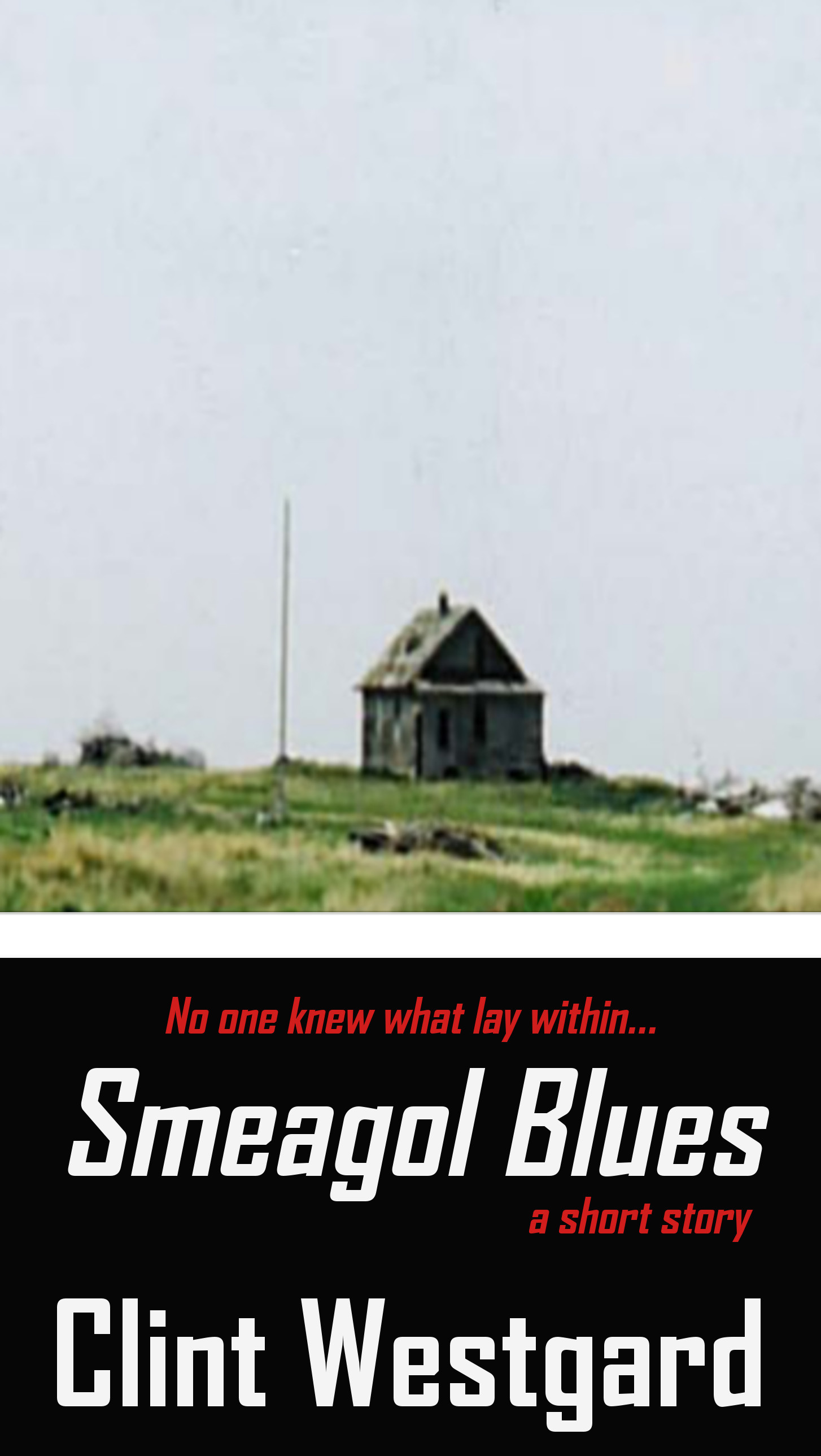
Now Available: Smeagol Blues

Smeagol Blues scaled

For as long as he can remember, growing up on the Canadian prairies, David has been drawn to the house. Called the Faulkenbourg Place by the locals after the Swede who had homesteaded the quarter, it is an unremarkable, ramshackle thing, worn by too many harsh seasons on the prairies. David’s curiosity will lead him to an investigation of the strange history of one of its inhabitants, Louie Glazer, a man who had disappeared without a trace thirty years before. Despite these  and other ominous signs he remains in its thrall, a power beyond his reckoning, that will lead him to an act of betrayal and a startling discovery as to the nature the nature of the place itself.

A short story by Clint Westgard
Available at Amazon, Kobo and Smashwords

What Lay Within

It was during that fall that his mother’s illness became inescapably apparent to David, the strange pallor that he had noticed that summer now a permanent feature of her face. There were other changes as well, though little noticed by him. His mother was always tired, often going to bed early in the evening when he and Eric did, and on particularly bad mornings it was their father who would rouse them get their breakfasts and send them off to the bus for school. Sometimes their usual after supper games, crib and rummy and kings on the corner, would be left to he and Eric alone.

The dim concern David felt for these developments, more a sense that this was unusual than any true understanding of what they implied, was offset by the arrival of harvest. It was his favorite time of the year, filled with bustle and activity, given greater meaning by the race to get the crop off before the weather turned.  This year his excitement was magnified by the addition to the proceedings of the new hired man, a fellow named Jim from Enchant.

The hired man and his father worked from dawn till dusk, so long as the weather held and there was wheat to harvest. When David came home from school he would take the two lunch pails his mother had prepared, full of sandwiches, sliced cucumber and tomatoes with some cookies for desert, and two thermoses full of tea out to the grain bins where Jim was unloading the truck. Jim would give him a ride out to the field, keeping up a friendly chatter that to David’s ears sounded worldly and wise, and then David would run one of the pails and a thermos over to the tractor and combine his father was driving.

He would sit beside his father, nestled precariously on the armrest, with the various unfathomable gear sticks threatening to jab him in the back, as he made his rounds in the field and ate his supper. He enjoyed watching the swath disappearing into the combine, transformed into kernels of wheat straw that would be spit out the back of the machine. His father did not really say anything in these moments, focused on his supper and the task at hand, but David did not mind. It was enough to watch, to hear the throttle of tractor and the rumble of the combine as they worked. Sometimes, if his father allowed it, he would stay out on the tractor until his eyes grew too heavy and then Jim would take him home for bed.

On the weekends they would all eat lunch in the fields, sitting in lawn chairs out on the stubble in the shadow of the machinery. The talk would be on the progress of the harvest, how this field was going tougher than the last, how the equipment was holding up, and how the weather might threaten or bless in the days to come. David would listen to these conversations with fascination, feeling a part of some monumental task, the import of which he could not quite grasp.

One day, Jim seemingly tired of all the talk of work, asked about the Faulkenbourg Place.

“Why do they call it that?” he wanted to know.

His father finished the bread he was eating and said, “Albert Faulkenbourg homesteaded that quarter. He bought the house and put it up there in twenty two or twenty three I think.”

“What happened to him? Get moved out in the Thirties?”

“No. The year after he built it he was killed. He was disking a field and something spooked his team. He was thrown off his seat and the discer went right over him. Dad found him the next day.”

“That’s a hard thing.”

“Yes it was.”

“Your family bought it after that?”

“No, it went through a few hands,” here his father paused tantalizingly, as though there were much more to be said. “Bit of a bad luck place I guess you could say. Land’s a bit sandy too.”

Jim stayed on through the winter and into the next fall as well. During the summer, when more of his time was his own and he had much more freedom to navigate, David would often make his way over to the Faulkenbourg Place to chat with the hired man, who didn’t seem to mind the company. He taught David how to throw a proper curveball and told him about the time he had batted against Satchel Paige when the Negro Leaguers were barnstorming through Saskatchewan.

As much as he enjoyed the Jim’s company, the larger purpose of his visits was to be within the house. It was a compulsion, deeper than any understanding he was capable of. The thrill he felt as he stepped from the entryway, to the kitchen or the living room, to sit across from Jim and talk was something near ecstasy, especially now that he knew what had happened to Albert Faulkenbourg. To be in these same places where a dead man had sat and done the same things he had was an incomprehensible and new thing to David.

Jim left in the middle of the next winter, a particularly harsh one, even by the standards of the Canadian prairies. The first snow had fallen a week after Thanksgiving and stayed on through November and into the new year, accumulating into vast drifts that hardened into immovable dunes, reshaping the landscape entirely. The drifts in the yard were so large and solid that the cattle could walk out of their pens and the tractors were unable to break through them. The temperature offered no reprieve, staying well below freezing so that even the slightest breeze was cutting.

It was in January, when the days were at their shortest, the sun setting before five, making the cold seem to set in the bone all the more, that Jim came by their house to announce his leaving. David was at the kitchen table playing cards with his mother while his father finished his tea and read the paper. Jim looked sheepish as he unbundled himself on the porch and apologized for disturbing their evening. His father waved away his concerns and poured them both a glass of whiskey. They retired to the living room to talk.

Though David made a great show of playing his hands, he lost three games in a row as he tried to play and listen to what was being said in the living room between the two men.

“I’m just here to give my notice,” Jim was saying. “Sorry to spring it on you like this.”

“You’ve got something else then?” his father said, in that even tone he used to indicate disapproval.

“No, not exactly yet.” Here Jim stammered. “I know some folks in Maidstone.”

There was a pause where David could imagine his father taking a measure of the situation while he took a sip of his whiskey. “Is there a problem, something you’re not telling me?” he said. “I think I’ve been fair in all our dealings. I could understand if you had something better lined up. Lord knows you don’t want to be doing this your whole life.”

Jim’s discomfort was plain in the way he spoke. “It’s not anything you’ve done. You’ve done right by me Walter. I can’t thank you enough for the opportunity. Just time to move on I guess.”

“There’s not something else wrong is there?”

“No, no,” Jim said and there was a long silence. “It’s the house, if I’m being honest. There’s something about it doesn’t sit right.”

“How do you mean?” his father said, sounding confused.

“I can’t explain it really. I just don’t feel right in it, like there’s something else there with me.”

“A ghost you mean?”

“No. I know what you’re thinking. Jim’s gone crazy. I swear to you, it’s nothing like that. I can’t explain it. I know there’s nothing there. Can’t be. But it just doesn’t feel right.”

They left it at that, his father thanking him for his help and wishing him the best. Later David would overhear him talking about the situation with his mother, saying that maybe it was a blessing that he had gone when he had. “He can’t be right in the head, thinking there’s something in that house with him. Who ever heard of such a thing?”

David knew what Jim had tried and failed to tell his father, that sensation that escaped all words yet sunk deep into the center of his being never to be shaken free. Jim had been afraid of it, though he had tried to hide it in front of his father. David, though, felt no fear, only a longing that somehow he imagined would be made whole by the place itself and whatever lay within.

From Smeagol Blues by Clint Westgard

Forthcoming April 2013

Forthcoming: Beware! The Seas Are Angry This Night

Beware scaled

“Captain, I don’t know what to tell you. The game has changed.”

And so it has, but the Captain is determined not to lose. He faces a host of problems though: the man he was supposed to make a deal with has betrayed him, turning on the Infernal Contraption which means death to everyone near it, and now he is forced flee passing through a city descending into chaos and violence. And then there is the Grand Jefe…

A short story by  Clint Westgard
Forthcoming May 2013